

It’s Not Enough for Washington and Lee to “Understand and Appreciate” its History
It’s Not Enough for Washington and Lee to “Understand and Appreciate” its History
It is essential that the next President proactively enhance historical awareness on campus and embrace all of the University’s history
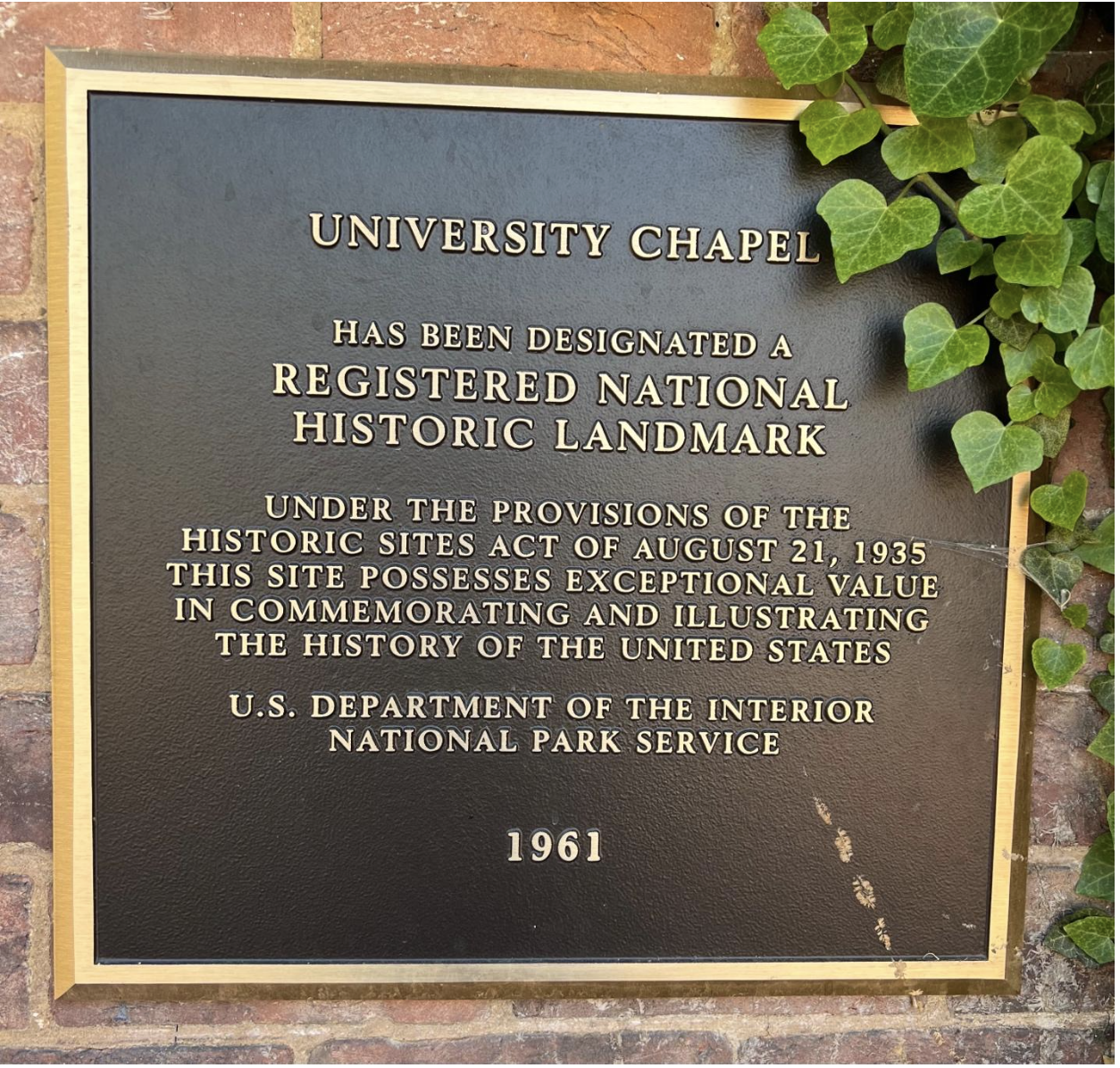
(Lee Chapel, National Historic Landmark Plaque. | SOURCE: Iain MacLeod ‘22)
Included within the recently released profile for Washington and Lee’s next President, in a list of “opportunities and challenges” he or she will face is the need to “understand and appreciate the University’s history.”
This might be optimistically viewed as a positive statement of the Presidential search committee’s commitment to the importance of history. I am an optimist, but I am not a naïve one, and this choice of words leaves me with the opposite impression.
There is no imperative action associated with “understanding” and “appreciating.” President Dudley, and the incumbent administration more broadly, have repeatedly and defensively asserted their understanding of and appreciation for Washington and Lee’s history, while systematically obscuring vital parts of that history.
As a few examples (but by no means an exhaustive list): Campus tours have ceased visiting Lee Chapel, National Historic Landmark, recounting its place in the history of Washington and Lee, or noting that Robert E. Lee and his father “Light-Horse” Harry Lee, both critical figures in American history, are buried therein. The University Store has scrubbed all items that reference either of the University’s namesakes in any context except the school’s name, except for one shelf of historical books hidden near the checkout line. The fine museum and shop in Lee Chapel’s basement were shut down in 2020, ostensibly due to COVID-19, but has remained closed since then with the shop being dismantled and converted into a small and very plain portrait gallery.
Lee Chapel itself has been (administratively) renamed “University Chapel.” In a particularly flagrant act of revisionism, the administration has placed a plaque at the entrance (see photo below) referring to the designation of “University Chapel” as a National Historic Landmark (NHL), even though NHL status is a federal designation and federal documentation explicitly refers to the site as “Lee Chapel, National Historic Landmark.” This is only one of the latest examples of revisionist obfuscations by the Administration. See a prior article I wrote for The W&L Spectator in 2022, shortly after the Chapel was renamed, for a further accounting.
Yet one should not be under the impression that the University has abandoned all history. Positive developments include emphasizing historical figures such as John Chavis, a free African American veteran of the Continental Army in the American Revolution, who studied at Liberty Hall Academy (precursor school to Washington and Lee) in the 1790’s prior to serving as a Presbyterian minister and educator in his home state of North Carolina. Another productive step has been the University’s addressing its past regarding slavery.
In spite of any protestations to the contrary, President Dudley and his administration spent nearly ten years systematically scrubbing any publicly visible connections between the University and Robert E. Lee specifically, all the while proudly proclaiming their appreciation for and understanding of Washington and Lee’s history.
This is an abject failure on the part of the University to embrace its own critical place in American History. Lee’s Presidency of Washington College is remarkable in the context of its alternatives. Lee could easily have accrued far more power and influence by pursuing political office, and far more money and easier living in the corporate world. Instead, he fully embraced the Presidency of Washington College, establishing himself as a remarkable educational innovator and administrator while vocally promoting reconciliation between north and south.
That legacy is a truly essential part of American history that should be embraced by Washington and Lee along with all other aspects of its history. Occasional token references to Lee’s contributions such as that buried deep in the Presidential Profile are woefully insufficient.
Washington and Lee’s campus is not some home-turned-museum where Lee spent one or two nights between battles. It is itself a critical piece of American History, a key place in the transition from the Civil War to Reconstruction, and, due to Lee’s educational innovations, a cornerstone in the development of American liberal arts education.
Declining to present this history where it actually occurred in favor of an editorialized museum looks more like a not-so-subtle play for narrative control than a good faith accounting of institutional history, particularly given the Administration’s extended track-record for obscuring Lee’s role. But even the fairest and most complete institutional history museum is insufficient when the real history is already right there. It would be a travesty for the University to settle for a President who just “understands” and “appreciates” the University’s history; what is needed is a President who will make a concrete commitment to re-emphasize the history we have all around us on Washington and Lee’s campus, particularly Lee Chapel.