
Continued Action in Iran Preserves American Hegemony
Continued Action in Iran Preserves American Hegemony
Although Operation Epic Fury is a start, further action is needed in Iran to reassert regional security and to gain a strategic advantage over our rivals.
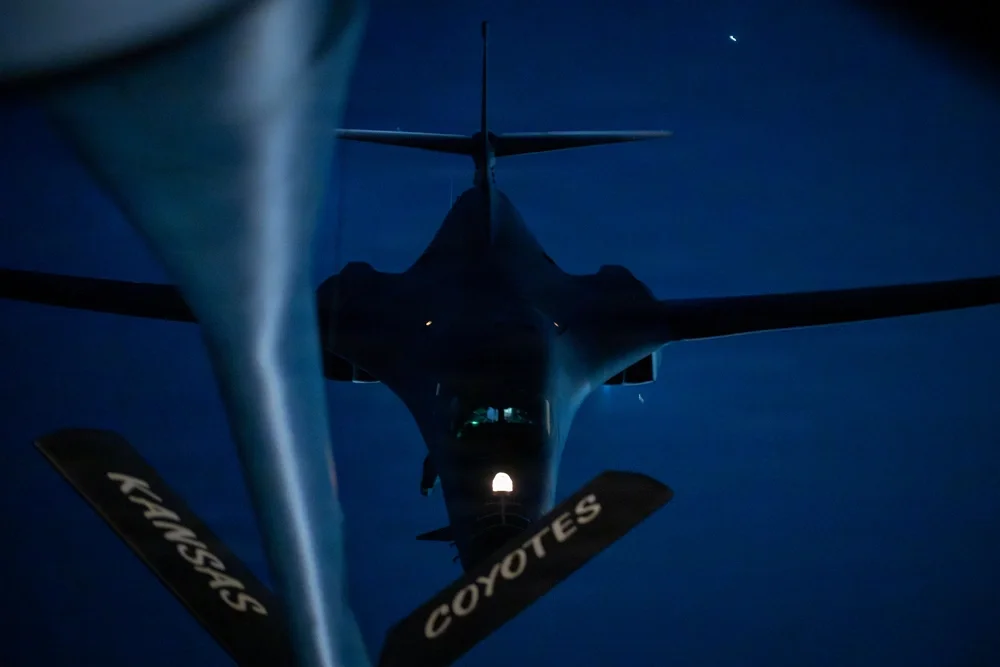
(A U.S. Air Force B-1B Lancer aerial refuels with a U.S. Air Force KC-135 Stratotanker while on a night-time mission during Operation Epic Fury. | SOURCE: U.S. Air Force)
The ongoing war in Iran is an operation marred by criticism. Polling conducted before the start of Operation Epic Fury by the University of Maryland found that only 21% of Americans were in favor of the United States attack on Iran. This distaste for military intervention in the Middle East is not without good reason, as Americans are constantly reminded of foreign policy failures in Iraq and Afghanistan, a wound reopened by the Biden administration’s catastrophic 2021 withdrawal.
However, while rising gas prices and uncertain financial markets may sway midterm voters, the benefits of a strengthened American hegemon, gained through long-term American influence in Iran, should motivate the Trump administration to persist despite unfavorable political conditions.
Iran’s allies and its proxies in the Persian Gulf are often described as an Axis of Resistance, dissipating Western influence in the Middle East and promoting regional instability that threatens American interests and global shipping lanes.
By engineering a horizontal proxy war — expanding conflict across the region through allied militias and non-state actors rather than direct confrontation — Iran has sought to challenge the critical role that U.S. influence has played in the Middle East since President Jimmy Carter’s 1980 State of the Union.
In his speech, Carter pledged that he would use any means necessary to preserve American interests in the Middle East after the Soviet invasion of Afghanistan. Yet, barring major proactive military involvement in the Persian Gulf since the end of Operation Iraqi Freedom, the influence of our rivals has once again permeated into its waters.
The sentiment portrayed by these rivals, namely China and Russia, has influenced the Islamic State (ISIS) and manifested in the death of Americans, such as in Jordan in 2024. With China receiving cheap oil and Russia obtaining inexpensive Shahed drones for use in the invasion of Ukraine, these rivals are using their power in the Middle East to secure economic benefits.
Operation Epic Fury rightly seeks to reestablish American dominance in the Gulf region at a time when our competitors are floundering. Recently, protestors have flooded the streets of Tehran, China has wrestled a growing deflationary crisis and Russia has continued a war that has surpassed all expectations of death and financial strain. All of this shows that there could be no better time for the United States to act.
While academia claims America’s unipolar moment has come to an end, brave Americans have embarked on a mission to liberate a region dominated by an oppressive and terroristic regime and to resecure the advantageous position on the world stage that slipped from our hands in the years following the collapse of the USSR.
It is not only Americans who recognize our unique geopolitical opportunity, but also a cautious China. Prominent Chinese scholars such as Zheng Yongnian describe America as having “formidable economic strength and unparalleled military power globally” following the recent outbreak of conflict in Iran.
The next challenge is to ensure that Operation Epic Fury translates to long-term success.
By pushing further beyond the preliminary goals of Operation Epic Fury, America can gain control of vast oil deposits and strategic shipping lanes. Furthermore, we can decimate a terroristic regime that has, at the bidding of Russia and China, consistently hurt American interests with missile strikes and targeted cyber-attacks.
While costly upfront, a sustained operation in Iran that is focused on securing the Persian Gulf will allow the US to control energy markets and protect the dollar-based financial system. These are key steps towards preventing future Chinese military dominance and deterring aggressive military action against US-aligned states.
The greatest strategic advantage of control over the Persian Gulf is the ability to regulate global oil markets. Combined with recent action in Venezuela and our demonstrated ability to target sanctioned oil tankers in our hemisphere, the ability to effectively sanction and regulate the global oil trade, especially in the Strait of Hormuz, would be key in preserving economic dominance.
Increasing our economic power in the global oil trade market could also minimize the threat of another World War. Controlling oil in past wars has greatly benefited the U.S., especially during World War 2, when oil embargoes forced unsuccessful and crippling Axis campaigns in the Caucasus and the Southeast Indies targeting oil reserves and supply lines. Similar restrictions could be used to prevent a Chinese invasion of Taiwan, a potential World War 3 scenario, and could force China to invest in inefficient and expensive sources of oil. It could also cause them to rely heavily on Russian and Kazakh oil imports, a dynamic that will create an exploitable dependence.
However promising, the opportunity presented in the Middle East will not come to fruition without unprecedented commitment and restraint to maintain a stable regional balance of power. By chasing regime change or an embellished nuclear program, we are certain to have a repeat of Iraq. However, by focusing on the aerial targeting of hostile military targets and maintaining a robust military presence in the Gulf, supplemented by an allied coalition, we may maintain long-term control of the Persian Gulf. We must do this for the good of the American people, the benefit of the free world, and the cause of peace in the Middle East.
The opinions expressed in this magazine are the authors’ own and do not reflect the official policy or position of The Spectator, or any students or other contributors associated with the magazine. It is the intention of The Spectator to promote student thought and civil discourse, and it is our hope to maintain that civility in all discussions.