
As Endowment Underperforms, W&L Questions Investment Approach
As Endowment Underperforms, W&L Questions Investment Approach
University Investment Committee examines Makena Capital partnership and conservative investment strategy after endowment underperformance contributes to budget constraints.
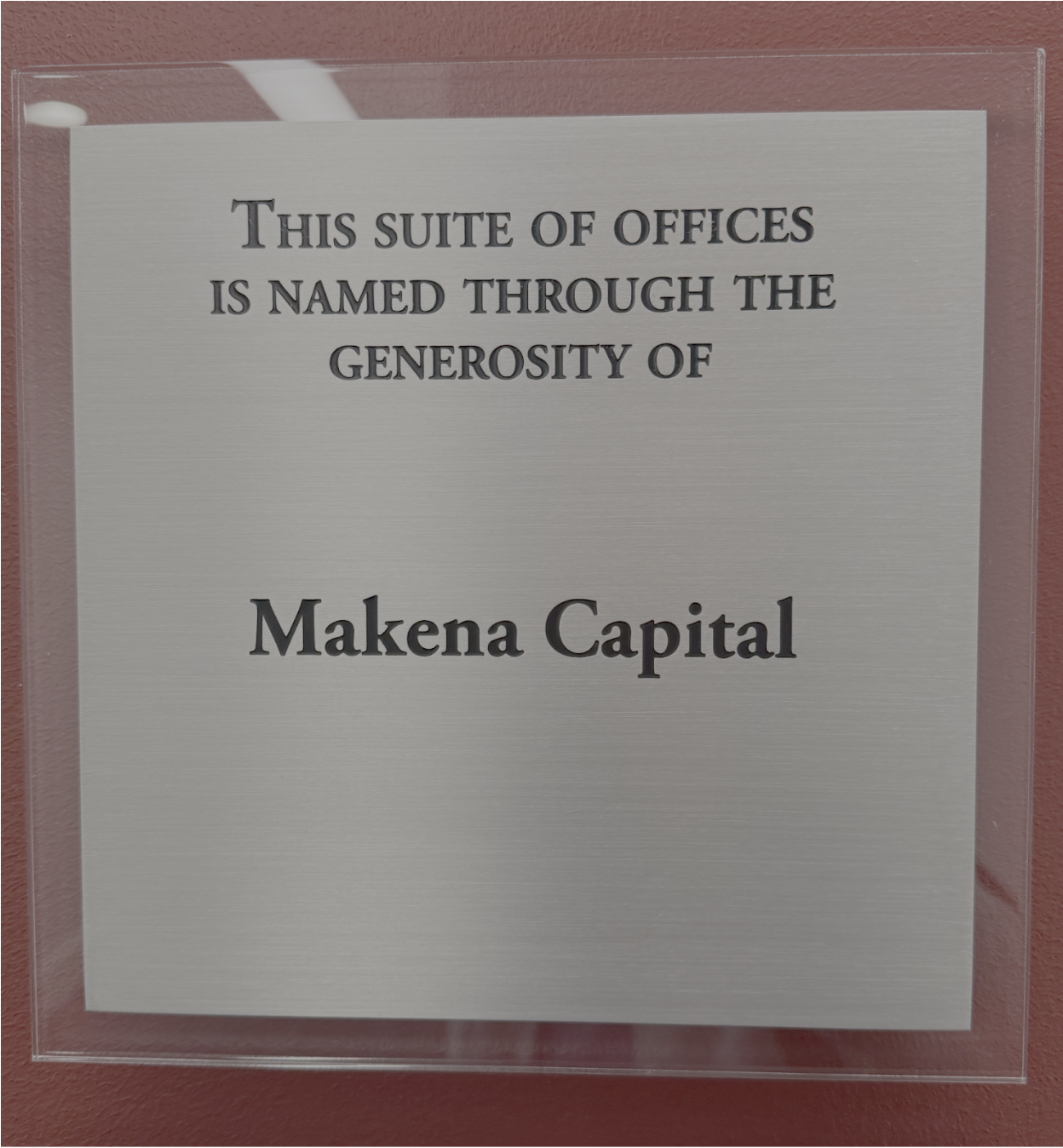
(Plaque for Makena Capital Management in W&L’s new Williams School Building. | SOURCE: Author)
Washington and Lee University is conducting an in-depth review of its investment strategy after the endowment repeatedly fell short of its 7.5% annual return benchmark, trailing peer institutions by 2% last year.
The endowment has met that goal only twice in the last seven years. Despite returning 9.6% in fiscal year 2024-25, a figure that excludes the faculty mortgage pool, W&L’s endowment still lagged behind peers, according to W&L Vice President of Finance Steve McAllister.
Peer institutions, McAllister told The Spectator, averaged 11.6% for the same year. Notably, W&L’s endowment saw an exceptional return of 36% in the 2020-21 fiscal year.
“We are well aware of how performance has been,” McAllister told The Spectator. “We know how it impacts budget and operations.”
Makena Capital directly manages approximately 90% of W&L’s $1.5 billion internally managed endowment and serves in an advisory capacity for the remaining 10%.
The Investment Committee, according to McAllister, is working to determine if “Makena [is] the right answer for us,” or if “there [is] something else that we should be pursuing.” Additionally, the committee is deciding whether W&L should “take on a greater level of risk” in its investment strategy to increase returns.
“The review,” McAllister said, “wasn’t driven by Makena’s performance. Frankly,” he continued, “it was simply a good time to do what is a good fiduciary responsibility of review.” That said, McAllister added that “performance has certainly played into” the questions the committee is examining.
“It’s leading to questions as to … is this still the right solution to us, or are there other options that we should be considering?”
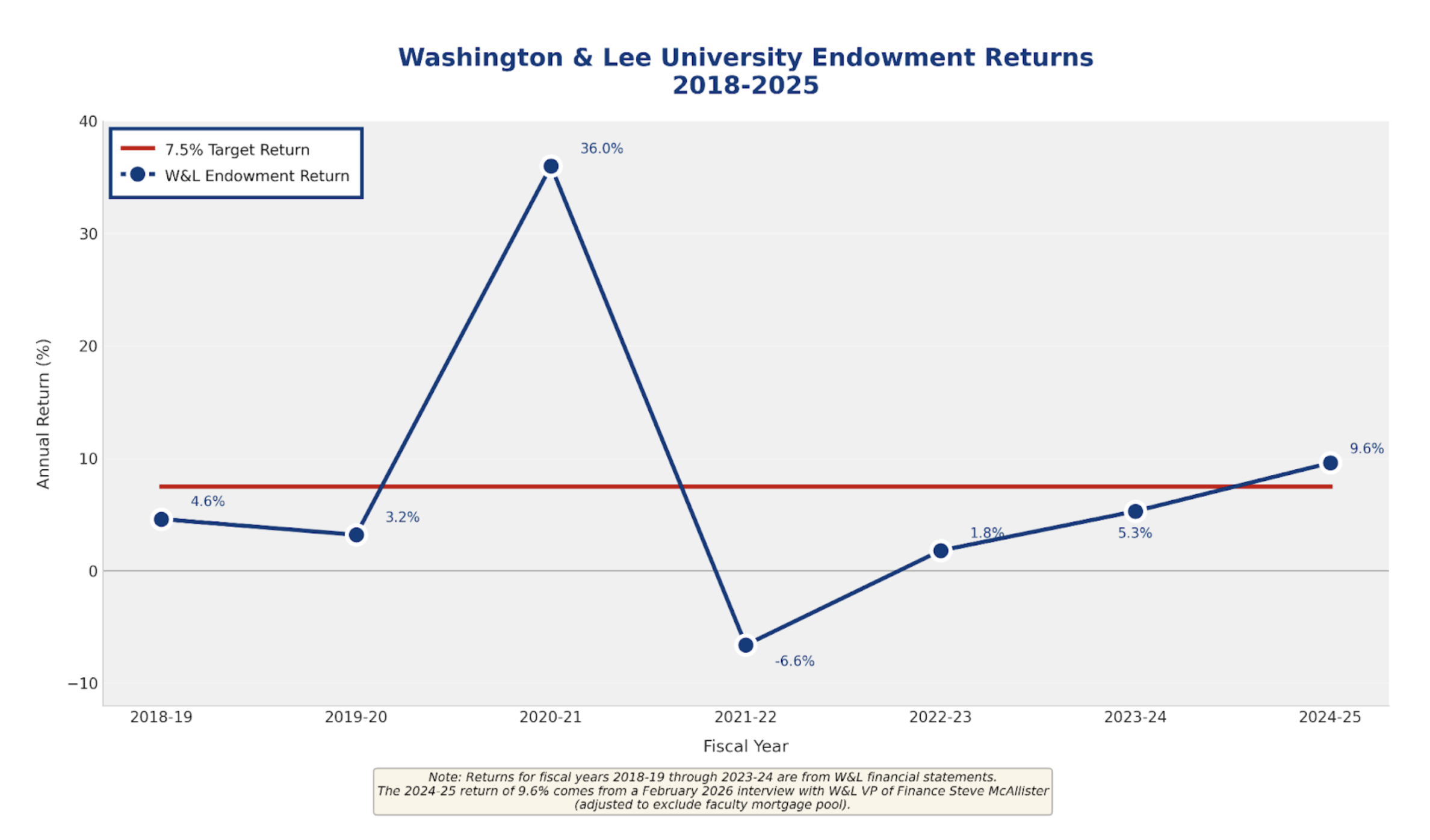
(Washington and Lee University Endowment Returns 2018-2025. | SOURCE: W&L Financial Statements and Steve McAllister)
“If you’re simply comparing the performance of our endowment with the market in general … we are doing really bad,” Dr. Afshad Irani, the chair of W&L’s Accounting Department, told The Spectator.
Below-target endowment returns have contributed to a 10% cut in discretionary funds for academic departments and come alongside rising tuition prices for W&L students. Additionally, W&L instructional staff salaries have declined 13.5% in inflation-adjusted terms since 2015, compared to a 7.8% decline among peer institutions.
Dr. Linda Hooks, chair of W&L’s Economics Department, told The Spectator that “it has had an impact on the work we do … mostly related to faculty salaries.” The Economics Department, she added, is fortunate to have alumni-established dedicated endowment funds to cover budget shortfalls.
Hooks added that academic departments have been told to expect a 0% budget increase this year.
Makena Capital’s underperformance compared to the market and competitors seems to stem from a handful of factors. According to McAllister, Makena “has had a heavy allocation to privates,” which “have lagged over [the] recent three years.” These include private equity, venture capital, real asset and natural resource holdings.
Information about specific asset allocation within the endowment is not available to the public. That said, McAllister told The Spectator that W&L has invested more heavily in real assets than peer institutions have.
McAllister added that returns on private investments are not recognized until they are realized. With the lack of realizations in recent years, university endowment returns have suffered. “We’re anxious to start to see some realizations, and we think with that, performance will improve,” he said.
“Private equity is hard to get out of,” Professor Hooks added. “Even if W&L saw [an] investment not playing out very well, they might have been stuck with it for a few years.”
Additionally, McAllister said that Makena was, until recently, disproportionately invested in emerging markets. U.S. markets have generally outperformed emerging markets in recent years, with the exception of 2025.
“Their allocation, I think, probably had been skewed. They have backed off on that,” he added.
Furthermore, McAllister questioned whether Makena has adopted an overly conservative investment structure over recent years, asking, “Could we take on a greater level of risk, and as a result, generate stronger returns?”
McAllister noted that student investment groups managing portions of W&L’s endowment underperformed Makena’s returns despite being heavily weighted toward equities in a year when equity markets performed strongly. As of March 2025, the student-run Williams Investment Society, which invests only in stocks, held $25.5 million in endowment funds under management.
The approximately $1.5 billion managed by Makena does not include parts of the endowment classified as “trusts held by others,” a category that constitutes approximately $712 million of the total $2.188 billion endowment as of the 2024-25 W&L financial statement.
McAllister told The Spectator that he hopes the Investment Committee report on the endowment will be completed by the end of this academic year, but emphasized that it could take longer because the Investment Committee aims for a high level of diligence. Once completed, the report will be presented to the W&L Board of Trustees.
The form of the report, as well as whether it will be made public, is yet to be determined.
Questions that are being explored by the Investment Committee include “looking at how Makena has done” and “how the relationship has changed since [W&L] joined Makena” in 2008, per McAllister.
“You have to beat inflation by at least what you’re paying out,” McAllister said, “with the hope that we might actually generate a little bit more,” so that the university can “build the endowment for future generations.”
W&L’s endowment challenges mirror a broader debate in higher education finance. Nationwide, college endowments frequently underperform index funds such as the S&P 500.
An analysis by Richard Ennis, former executive editor of the Financial Analysts Journal, argued that elite endowments are falling behind due to large allocations to alternative investments. Ennis emphasized that the high expense ratios of private equity and hedge funds significantly reduce returns.
On the other hand, Michael Azlen of Frontier Investment Management argues that a high degree of investment diversification is critical to lowering risk for large institutions.
McAllister told The Spectator that “if you look at modern endowment portfolio theory, there’s a lot about it that is built around diversifying … and the implication is that there isn’t a price for that.” “In truth,” McAllister continued, “there are certainly periods where diversification limits returns, especially when those periods include strong public equity markets.”
Makena Capital Management did not reply to multiple requests for comment.