
Is Grade Inflation a Problem?
W&L and universities nationwide question if and how to handle rising expectations and results.
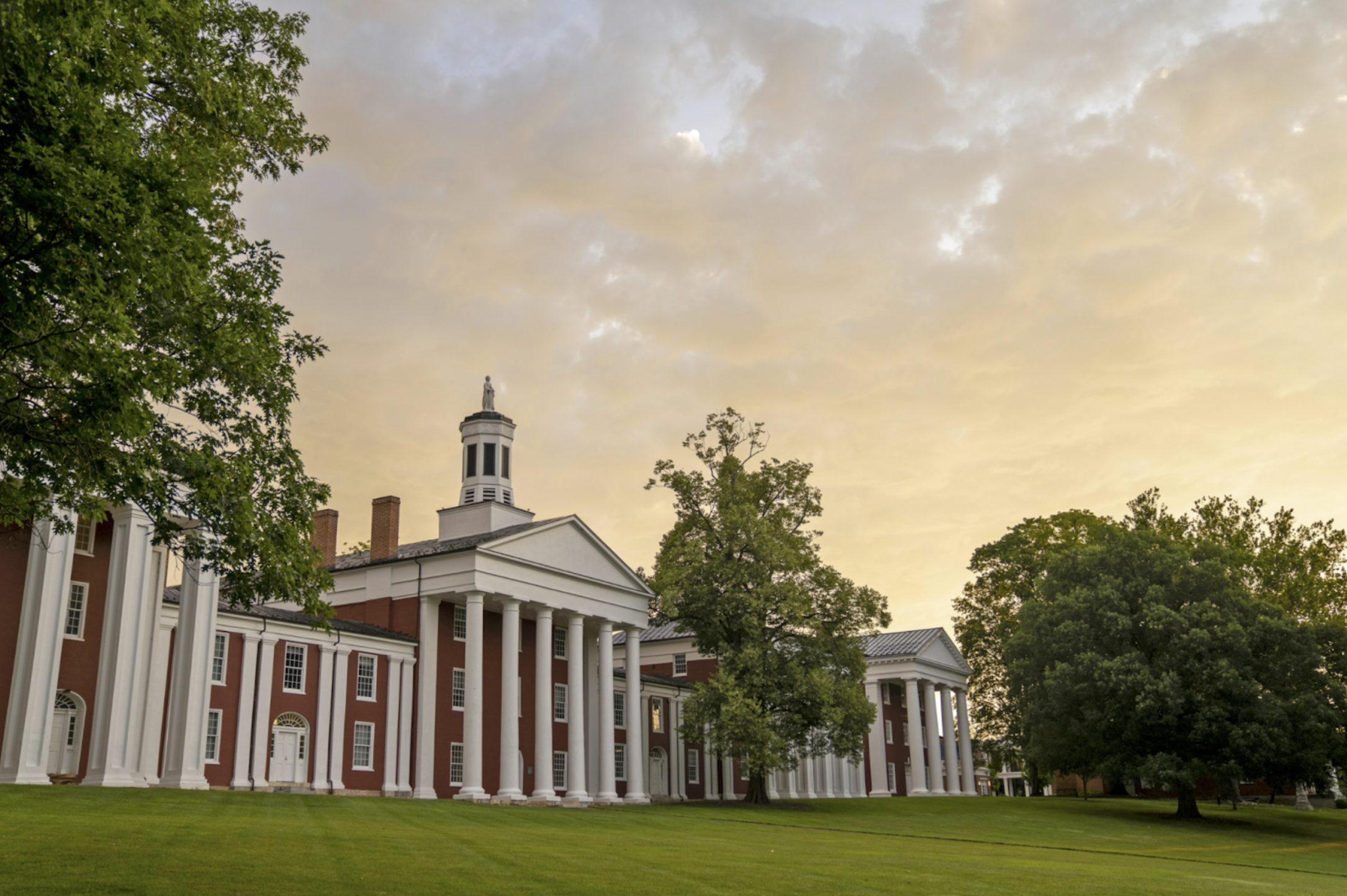
(The W&L Colonnade. | SOURCE: The Columns)
At Washington and Lee University, a grade point average (GPA) that once placed a student comfortably in the middle of their class would now fall well below average. If a student graduated from W&L in 2005, they needed a GPA above 3.325 to be in the top half of their class. By 2025, that number climbed to 3.715. The causes of this shift, and whether it is a problem, are disputed.
The trend mirrors a national pattern of rising grades. Much of this shift occurred during the years impacted by COVID-19 policies. In 2019, the top third of the W&L graduating class had a GPA of 3.622 or higher. By 2023, that number rose to 3.815.
At the end of the 2020 winter semester, students could choose to receive a regular letter grade or simply a pass/fail designation. Due to the extraordinary circumstances of a mid-semester lockdown, “it was a time where students were given a lot of leeway in general,” according to Economics Department Chair Linda Hooks. Grade optionality did not extend beyond that one semester.
For some faculty, the underlying issue is whether grades still serve their core function: distinguishing levels of performance. Williams School Dean Robert Straughan told The Spectator that “if grades lose their meaning, employers and graduate programs lose an important evaluative criterion. Based on anecdotal feedback that I’ve received, that is already happening.”
According to Hooks, it has become “very hard to distinguish who has really performed academically at a special level.” Furthermore, Hooks added, “a low grade means perhaps this is not the subject you want to continue pursuing,” but “students aren’t really getting that message anymore.”
On the other hand, Hooks points out, some would argue that W&L should not resist national trends “because the rest of the world has gone through grade inflation and our students need to be able to compete.” According to Hooks, low GPAs relative to peer institutions could harm W&L students after graduation, especially with employers that don’t check how students compare to their peers and only see the GPA without context.
Professor Elliott King, chair of the Department of Art and Art History, said in a written statement to The Spectator that the rise in grades should not automatically be understood as inflation.
“In many cases,” King said, “stronger teaching practices—such as clearer expectations, more structured assignments, and better feedback—lead students to perform at a higher level.”
According to King, “that’s a different phenomenon than grade inflation. When students understand what is being asked of them and receive meaningful guidance, stronger performance is often the result.”
As Straughan told The Spectator, “the causes are varied, including an evolving understanding of teaching and learning, both university and secondary school grading norms, the pandemic, and more.”
Hooks said that changing student expectations is partly driving the rise in grades. “Some of it is students who are now accustomed to getting all As all the time and are a lot more willing than they used to be to push back on a grade that’s not an A.” Hooks added that Covid-era mental health concerns contributed to the rapid grade inflation of 2019-2023.
Furthermore, according to Hooks, “some of it is pressure for assistant professors to be liked on their evaluations.” Student feedback can significantly affect their career outcomes. “I think assistant professors feel even more pressure than most about grades,” Hooks said.
According to others, grading pressure and good teaching evaluations are not inherently in conflict. Professor Afshad Irani, chair of the Accounting & Finance Department, told The Spectator that “you can be a fantastic teacher and yet not give high grades.” He referenced another professor at W&L who gives “very challenging” exams and yet “is one of the most liked professors in this school” among students. Irani attributed this reputation to the professor’s willingness to give students useful feedback and their overall skill as a professor.
King said that W&L students, who are “highly motivated and academically prepared,” can meet demanding expectations when provided with adequate support. “For that reason,” King continued, “I think the more important question is not simply whether grades are higher than they were decades ago, but whether students are developing strong analytical skills and engaging seriously with course material.”
King implements this methodology by allowing students to revise their work in response to feedback. With this, King said, “their performance often improves significantly, and the final grade reflects how successfully they meet the goals of the assignment and develop the skills the course is designed to teach.”
Grade inflation has not affected all academic departments equally.
Irani told The Spectator that he is “95% confident that Accounting & Finance as a department has the lowest GPA on campus.” He attributes this to an internally set departmental norm for grade ranges.
Irani told The Spectator that he is fairly confident that the Accounting & Finance department has the lowest average GPA on campus. He attributes this to “assigning grades students have actually earned.” For the required courses within the major, grades are also “consistent with an internally set departmental norm for grade ranges.”
According to Irani, his department will have 75 majors this year, the most it has ever seen. “We take care of our students, we challenge them, they get fair grades, and the proof is in the pudding in terms of new students coming into the program,” Irani said. The challenges that students face, Irani added, help to prepare them for the CPA exams and their post-graduation careers.
Straughan told The Spectator that “a lower percentage of A-range grades (A+, A, A-) are assigned in the Williams School, and a higher percentage of B-range grades (B+, B, B-) are assigned in the Williams School.”
While some departments within the Williams School have created “recommended grade ranges” which guide faculty, Straughan added that “grades ultimately fall to the individual instructors.”
“I do not think that inflating grades helps accounting majors in the long run,” Irani told The Spectator. “Perhaps they get happy in the short run, but that inaccurate sense of achievement may hinder their ability to pass professional exams and ultimately be successful in their careers.”