
Yale Professor Addresses Birthright Citizenship and Constitution
Yale Professor Addresses Birthright Citizenship and Constitution
Yale Law School Professor Keith Whittington delivers Constitution Day talk on the constitutionality of birthright citizenship.
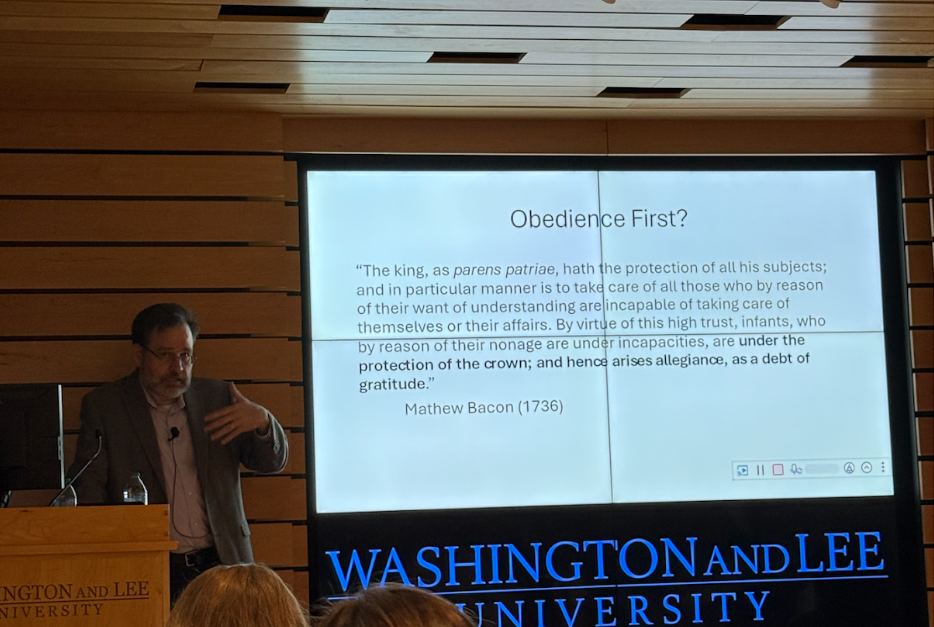
(Professor Keith Whittington delivering his presentation about the constitutionality of birthright citizenship in Washington and Lee’s Northen Auditorium. | SOURCE: Author)
“Subject to the jurisdiction thereof” represents the main point of content when it comes to evaluating the constitutionality of birthright citizenship.
Professor Keith Whittington spent considerable time discussing this phrase, its backings in English common law, and application throughout American history in his Constitution Day talk on September 18, 2025 in W&L’s Northen Auditorium.
Whittington serves as the founding chair for the Freedom Alliance Academic Committee. He also serves as a visiting fellow for the Hoover Institution and has his works in many prominent publications such as The Wall Street Journal and The New York Times.
Whittington began his talk by stating that the topic of birthright citizenship “was a topic I wouldn’t have bothered writing about a few years ago … because it seemed pretty well-said.”
He acknowledged that as of recently, “how we thought about the law … has changed dramatically.” This change made it more pressing “to reexamine this question about what birthright citizenship entails, who falls within it, and what the rule of law is surrounding it,” he remarked.
Whittington’s approach to examining birthright citizenship and the Fourteenth Amendment “draws heavily on sort of what the preceding common law was, both in England and the United States.”
He referenced a tweet from President Trump during his first term as evidence for the shift in thinking about the application of the Fourteenth Amendment. In this tweet, the president stated that the words “subject to the jurisdiction thereof” serve as an argument against birthright citizenship.
He then stated that President Trump “acted finally on this [the tweet]” by issuing an executive order to alter the scope of birthright citizenship. This order proclaims that “the Fourteenth Amendment has never been interpreted to extend citizenship universally to everyone born within the United States.” It follows that children born to parents who were unlawfully present or on lawful, but temporary visas do not automatically get American citizenship.
Whittington then discussed the drafting of the Fourteenth Amendment, pointing to how Abraham Lincoln’s Attorney General Edward Bates, in 1861, believed that generally “every person in this country is born a citizen.” This belief closely resembles an earlier “long-standing rule” in the British common law, which said that “if you're born in the country, you're a citizen, according to Whittington.
However, Whittington did acknowledge that there are a few well-established exceptions to birthright citizenship. He claimed the traditional exceptions were for “foreign ambassadors” and “invading armies,” because these groups are “not actually subject to the jurisdiction of the United States,” being “extensions of a foreign government.”
The other, uniquely-American exception was that of Native American, who until 1924 were not birthright citizens. This is becausethe United States govenrment considered Indian tribes to be “quasi-foreign,”with the federal government engaging “with them through diplomatic relationships rather than through normal municipal government relationships.”
Then, Whittington transitioned to discussing the origins of birthright citizenship in English common law. He talked about how it was acknowledged that whenever a person was born, they owed “allegiance to his sovereign,” even if the person was born outside the territory. He used these principles to illustrate a few examples of these principles in action, through their influence on American birthright citizenship jurisprudence.
Afterward, Whittington addressed several common arguments against birthright citizenship, particularly regarding jurisdiction and allegiance.
One of the arguments was that “aliens who are just passing through or aliens who are even living in the country owe allegiance elsewhere” and thus “are under the … complete jurisdiction and allegiance of the United States.” Some people also claim that illegal aliens who enter the country because “they are disobeying our laws when they arrive in the country,” are also not under complete U.S. jurisdiction. Whittington then argued that common law does not support these arguments, citing William Blackstone’s commentaries on the subject, in which the English jurist supported birthright citizenship.
Ultimately, Whittington’s argument sought to contextualize birthright citizenship as a common-law tradition, tracing its history back to before the American nation became independent. He barely referenced the current administration’s argument against the principle, instead opting for a more holistic interpretation of the clause as an American legal tradition.