

The Department of Education Must Go
The crisis of the national debt and repeated failures show that the Department of Education must no longer exist.
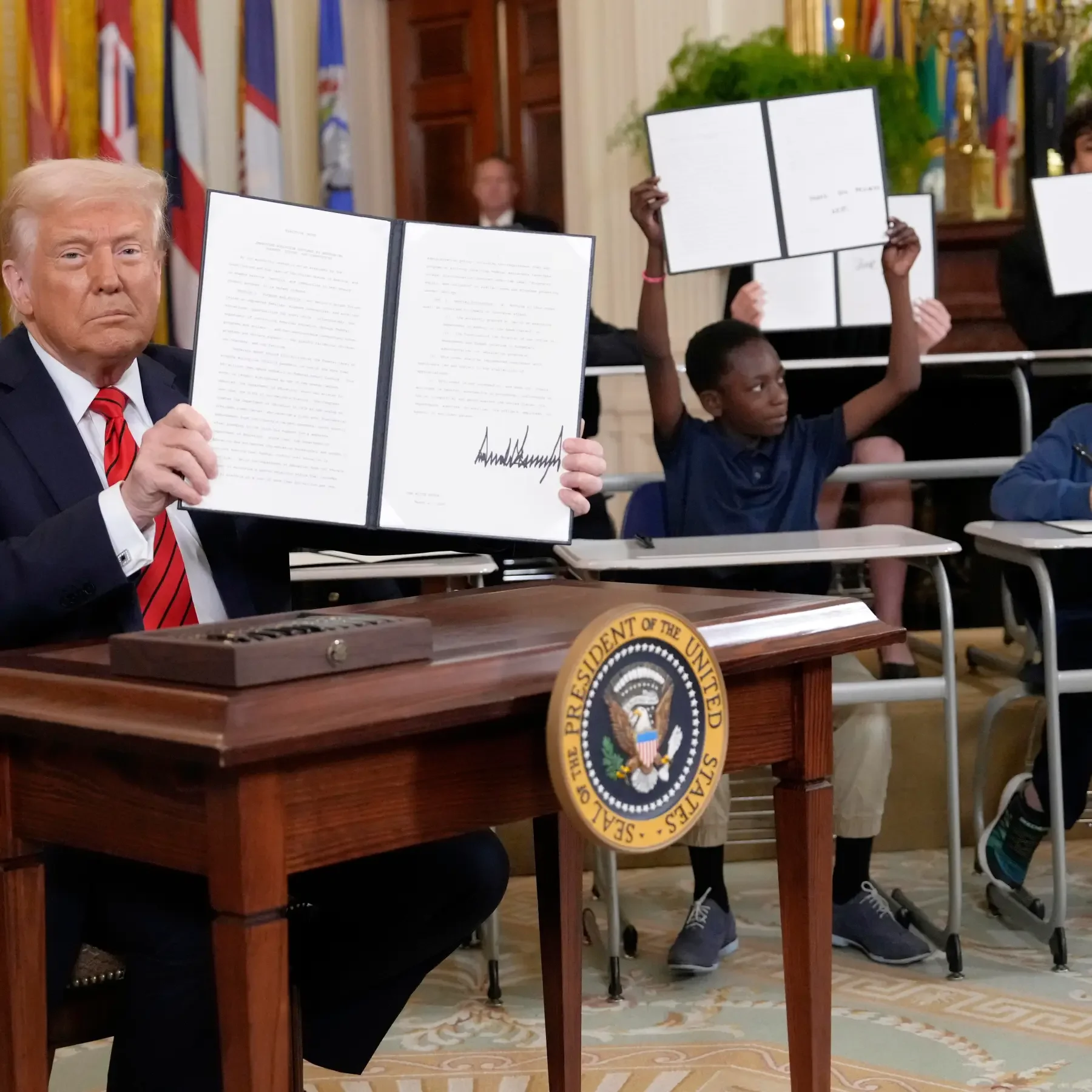
(President Trump shows the executive order to dismantle the Department of Education. | SOURCE: Ben Curtis / AP Photo)
Early in his term, President Donald Trump signed an executive order to effectively close the Department of Education, ordering the secretary of education “to facilitate the closure of the Department of Education and return authority over education to the States and local communities.” Trump’s efforts continue a trend throughout modern American history where conservatives have sought to eliminate the Department, famously arising from President Reagan’s desire to have the Department “abolished.”
President Trump’s efforts to dismantle the Department of Education cannot come fast enough, and should be welcomed by every American who cares about our nation’s education system.
There are three reasons why the Department of Education should finally be eliminated. First, it will save taxpayers’ wasted money. Second, education should be left to the states to avoid infringing upon constitutional principles. Third, and most importantly, the Department has failed American schoolchildren in its unachieved goal to secure them a high-quality education.
It is clear to most Americans that our country is in a spiraling debt crisis. Both parties use the national debt as a talking point, but neither party has done anything of substance to alleviate the issue.
President Trump, in his second term, is taking a step in the right direction by moving to eliminate the Department of Education. In the 2024 fiscal year, the Department’s total spending was around $268 billion, which accounted for about 4% of federal outlays.
While this figure may seem small in comparison to the almost $38 trillion of debt, it is still significant. The reality is, when addressing the national debt, we cannot aim for major, trillion-dollar cuts, because many services that Americans depend on day-to-day, such as Social Security and Medicare/Medicaid, come through the federal government.
Instead, we must aim for realistic cuts in different sectors of the government, which together will remove unnecessary spending from our budget deficit.
Next, federal involvement in education is fundamentally at odds with the traditional constitutional principle of federalism. The Constitution does not even mention the word “education,” which means it certainly does not give the federal government power to regulate education.
In fact, the Tenth Amendment reserves powers “not delegated to the United States by the Constitution, nor prohibited by it to the States, … to the States respectively, or to the people.” Therefore, according to the Constitution, the regulation of education is a power reserved for the states.
In addition to constitutional principles, common sense dictates that a deeply personal and local issue like education is best left to the local and state governments, where the people are more properly and personally represented.
The federal government setting national standards for education simply does not make sense because each state is so different in its educational priorities, laws, and demands from its constituents. For example, if a more liberal state wants to teach using methods like critical race theory, it should have the power to do so. But the federal government should not force educational standards or curriculum on the state governments.
(The U.S. Department of Education, in Washington, D.C., pictured on February 21, 2021. | SOURCE: Graeme Sloan / Sipa USA via AP Images)
In terms of impact, federal funds account for only about 10% of total educational revenues. This means that removing the Department would not have as negative an impact as people think, because states already handle most educational issues. And if that is the case, then why are American taxpayers spending money on a federal Education Department that has not succeeded in its mission?
It is critical to evaluate how well the Department has accomplished the purposes it was set out to achieve. On its own website, the Department says its function is “to promote student achievement and preparation for global competitiveness by fostering educational excellence and ensuring equal access.”
In terms of global competitiveness, it is embarrassing that many other democratic nations outperform the United States in science and math. In a study conducted by the Program for International Student Assessment, the United States ranked 28th out of 37 countries in math and 12th in science when compared with other countries in the Organization for Economic Cooperation and Development (OECD). Because of these poor rankings, it is clear that the Department of Education has not met its mission to prepare students “for global competitiveness,” as Americans lag behind students from many other countries in education.
Some other significant key points we must assess when it comes to American education versus other countries are in higher education and employment. The current administration has announced a $100,000 fee for new applicants for the H1-B Visa program, which would make it harder for U.S. companies to hire highly-skilled foreign workers.
This action is very telling because it very clearly reveals the underlying problem with American education, which is that American students are a minority in highly–skilled industries. For example, in American universities, international students account for “73% of full-time graduate students in electrical and computer engineering.” Additionally, 66% of technology workers in Silicon Valley are foreign-born.
Now, one cannot blame American companies for looking to foreign countries for employees, but it is problematic that Americans are not in these highly skilled industries, which are fueling America’s AI revolution. The problem starts with education, and Americans’ lack of representation in highly-skilled industries is partly due to organizations like the Department of Education consistently failing to improve educational outcomes for Americans.
Domestically, the Department has been unsuccessful in improving student aptitude scores since its inception. According to a graph from Andrew Coulson at the Cato Institute, over the past several decades, funding for education has increased substantially, while student scores for reading, math, and science have remained largely stagnant.
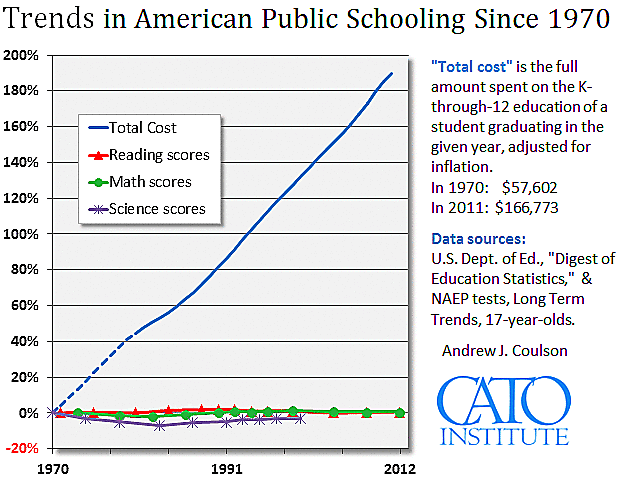
(A graph showing spending on education compared with student scores in reading, math, and science | SOURCE: Andrew J. Coulson / Cato Institute)
What is the point of increasing spending on education when those funds clearly have not improved student outcomes?
In addressing the argument that the Department has crucial functions such as managing student loans, taking care of children with disabilities, and ensuring that civil rights in education are upheld, it is important to acknowledge that other federal agencies are better suited to handle these functions.
As demonstrated by the “Returning Education to Our States Act” introduced by Senator Mike Rounds of South Dakota, it is clear that the Department of Education’s core responsibilities can be transferred to other departments. For example, the bill delegates “all functions, programs, and authorities of ED [Education Department] under the Individuals with Disabilities Education Act” to the Department of Health and Human Services.
Additionally, the Federal Pell Grant and several federal loan programs would be transferred to the Treasury Department, and the Department of Justice would be responsible for enforcing federal civil rights laws. All of this demonstrates that the Department is unnecessary, as its functions can be transferred to departments specializing in the areas it has previously addressed.
In sum, the Department of Education must go. It is hardly economically viable for taxpayers. It is more attuned to constitutional principles and our fundamental governmental principles. Finally, the Department is failing Americans.
It has not increased America’s educational competitiveness or improved educational outcomes for students. It is the classic example of wasteful spending– throwing money at an issue for minimal results. American taxpayers should not be forced to pay for a failed bureaucratic agency that usurps their states’ rights to regulate education.