

The Single Sanction is the Essence of the Honor System
The Single Sanction is the Essence of the Honor System
The two institutions are inseparably linked, a reality we must acknowledge to improve the Honor System.
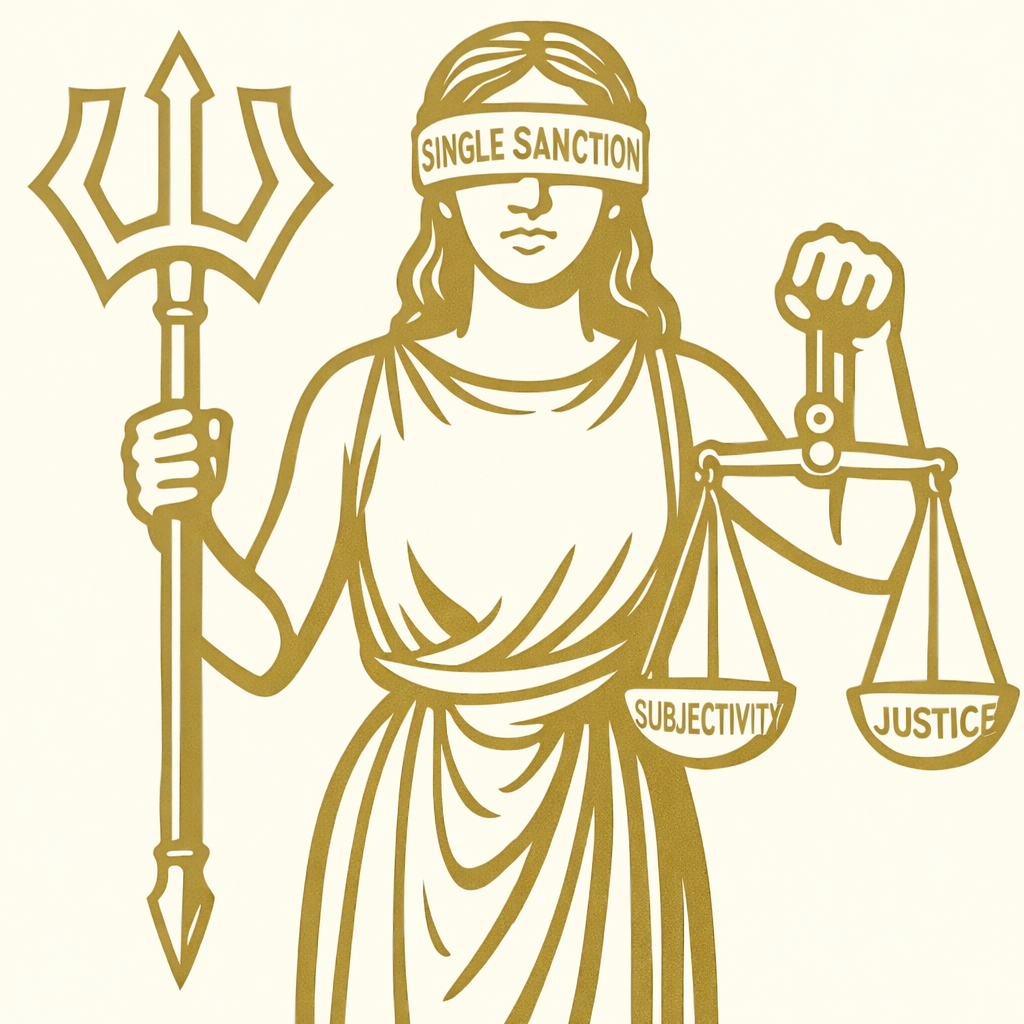
(Lady Justice and the Honor System’s core values. | SOURCE: ChatGPT)
The ongoing debate over what the Honor System is and should be, particularly as regards the Single Sanction, is an extension of broader discourse regarding the nature of society itself.
The progressive view frames society as a collective that should be organized to promote shared goals to engineer progression towards an improved social state. In this framework, individuals are judged only with reference to the collective and have no responsibility beyond that of the collective interest.
The conservative view holds that the individual is society’s basic unit, and that, as an organization of individuals, the structure of society should maximize individual freedom by promoting personal responsibility. It is upon this principle that the Honor System was founded.
The Honor System was never intended to be, and has never functioned as, a one-stop shop for regulating student conduct. The student body of Washington and Lee instead adopted the Honor System to promote a higher standard of conduct than usually required in college life, leaving all other authorities to regulate their respective spheres (be they the government, family, etc.).
The traditional Honor System addressed academia’s inability to prepare students for the ethical challenges of postgraduate life. Existing methods, such as honor codes, were (and are) insufficient for regulating conduct. They address only specific behaviors through a system of punishments for infractions, not the underlying lack of character indicated by those behaviors.
Furthermore, codes are limited to punishing defined infractions, conditioning students to view as acceptable anything that does not violate the letter of the law, instead of pursuing the highest possible standard of conduct.
The Honor System’s uniqueness extends to its enforcement, which is carried out by students rather than administrators or faculty. To entrust self-regulation to students, two conditions must be met: students need a precise reference point for what constitutes dishonorable behavior and a clear consequence for engaging in it.
In the traditional Honor System, the first condition was satisfied by establishing lying, cheating, and stealing as clear examples of dishonorable behavior, while the second condition was satisfied by the Single Sanction.
Everyone knows lying, cheating and stealing are wrong, but many adopt these behaviors anyway because the consequences are less substantial than the benefits of adopting them. Establishing these behaviors as clear Honor Violations shifted the burden of conduct back to individuals – students were responsible for exercising self-discipline and elevating their conduct to ensure it would be considered honorable by their peers.
Self-control that exceeds its self-interested utility is impossible to maintain without an elevated consequence for non-compliance. This is why not only a single sanction, but the Single Sanction of expulsion, was essential.
The elevated consequence of expulsion exceeded the personal sacrifice associated with pursuing the highest standard of conduct one could imagine. So students elevated their conduct accordingly. This virtuous cycle, rooted in the Single Sanction, was the essence of the traditional Honor System.
Unfortunately, the 2006-07 academic year saw lying, cheating and stealing relegated to mere “historical” examples of Honor Violations. This was followed up a decade ago by the complete removal of all three Honor Violations from the White Book, even as historical examples. Honor has been reengineered, in perfect parallel with this removal, into a subjective concept defined solely as maintaining a “community of trust.”
Returning to the conservative-progressive dichotomy, the new “community of trust” framework simultaneously lowers the standard of conduct for individuals while reframing the system as a collective enterprise. The impetus for elevated self-discipline is gone, because the Honor System is no longer primarily concerned with individual conduct, but with an almost totally subjective “collective good.”
The Single Sanction is the final link to the Honor System as it was and as it should have remained: a system that endowed individual self-discipline and built a foundation of honor that would last a lifetime. As long as the Single Sanction stands, there is a path, narrow though it may be, by which the Washington and Lee student body can return to the traditional Honor System which served generations of students so well. Conversely, if the Single Sanction is ever repealed, we will irretrievably lose the Honor System.
It’s my understanding that this year’s Constitutional Review Committee is also considering possible amendments to the White Book. If this is the case, I appeal to both the Constitutional Review Committee and the Executive Committee to reverse the decades-long trend towards subjectivity and empty collectivism, and to recodify lying, cheating and stealing as clear examples of Honor Violations in the White Book.
These reforms would be a profound and positive step towards reestablishing the virtuous cycle of elevated expectations and consequences that for so long forged exceptional character in Washington and Lee graduates.
The opinions expressed in this magazine are the authors’ own and do not reflect the official policy or position of The Spectator, or any students or other contributors associated with the magazine. It is the intention of The Spectator to promote student thought and civil discourse, and it is our hope to maintain that civility in all discussions.