

The Faithful Speak, the Sovereign Trembles
The Faithful Speak, the Sovereign Trembles
Moderate Catholics are one of the most consequential segments of the electorate.
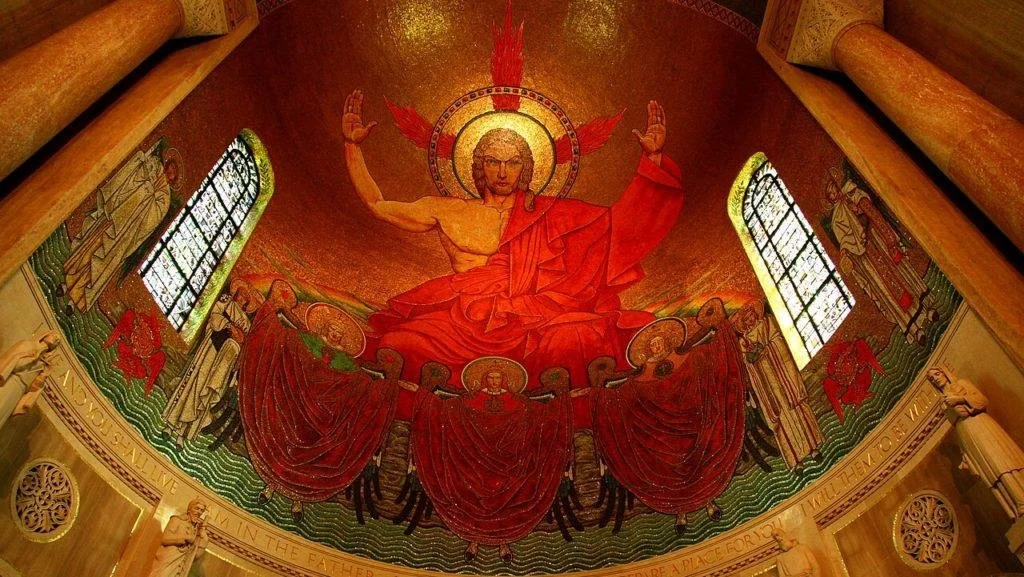
(A Christ in Majesty mosaic at the Basilica of the National Shrine of the Immaculate Conception in Washington, D.C.| SOURCE: Bradley Weber)
Moderate, practicing Catholic voters are in part responsible for Trump’s stunning 2016 upset, his political exile in 2021, and his shocking return in 2024. This group of independents will continue to weigh heavily against incumbents, as their faith tradition crosses traditional party lines.
Large numbers of Catholics began arriving in America in the mid-1800s. For over a century, they aligned almost exclusively with the urban machines of the northern wing of the Democratic Party. The northern white Anglo-Saxon Protestant ruling class, more likely to engage in anti-Catholic rhetoric, was usually Republican. Many Catholics aligned with the New Deal coalition because of its opposition to laissez-faire capitalism, which was contrary to Catholic social ethics. This alignment continued until the election of JFK.
As Catholics integrated into the middle class, their views came to resemble the broad diversity of American political thought. Their newfound prosperity inclined some of them to desire lower taxes and fewer regulations, aligning with the rest of the middle class. The Democrats embracing progressive social issues following the Sexual Revolution expedited this shift to the right. This didn’t necessarily impact non-practicing Catholics, who were significantly less likely to base their political affiliation on a tradition they were only loosely associated with.
After 60 years of drifting to the right, Catholics are nearly evenly split between both parties. Aside from the landslide victories of 1976 and 1984, the first time a Republican won the Catholic vote in a competitive election was in 2016 with Donald Trump, with a margin of 52-45.
However, in 2020, Biden flipped the vote, winning it 50-49. Catholics then flipped again in 2024, with Trump winning them 55-43. His win indicates the existence of a group of moderate Catholic voters who are bellwethers for the rest of the electorate and have helped the challenging party oust the incumbent.
There are two main objections a skeptic might make. The first is that this is not something unique to Catholic voters. A candidate who wins an election should see an increase in support across virtually all demographics. But this simply isn’t true. White evangelicals voted at higher rates for Trump in 2020. Religious “nones” (individuals who are neither religious nor atheist) did the same. More white women voted for Trump in 2020 than in 2024.
Second, one could argue that Catholics are such a broad category of voters that they cannot be qualified as a cognizable demographic. Catholics can indeed be found across racial, class, income and gender lines. However, what separates them from another amorphously large group like “Protestant” is the structure of the Church.
With complex degrees of dogma and doctrine on even the most minute of theological, moral, and social issues, the Catholic Church is the only group of Christians that strives for such a high degree of unity. This is enforced by a visible hierarchy of bishops, culminating with the Pope. Does this uniformity actually play out in reality? No. One would hear a much different homily on the Sunday after last November’s election in rural Indiana than one would in New York City.
However, while merely cultural Catholics might care very little, practicing Catholics have a visible and detailed standard by which to judge their political inclinations.
This is not the case for other groups. Additionally, Catholics have a rich history of voting together based on Church teachings. Therefore, it’s relevant to examine the Church’s teachings on critical electoral issues. Throughout the last decade, Pope Francis consistently condemned abortion, transgender ideology and other socially liberal issues. He also criticized Trump’s immigration policies and his perceived lack of compassion for the poor and the needy. Specifically, he stated both abortion and mass deportations are “against life," adding that Catholics should “pick the lesser of two evils.” These statements illustrate the uncomfortable choice faithful Catholics face when deciding who to vote for.
Catholics are far from monolithic, possessing vast swaths of pro-choice and anti-immigration individuals. Views on abortion and other partisan issues will vary wildly if one is asking a liberal or conservative, secular or practicing Catholic. However, Trump was more moderate on divisive issues like abortion, leaving room for more liberally minded voters to feel comfortable voting for him, while Harris looked like a radical.
Certainly, Catholics are not obligated to adhere to a pontiff's personal opinions. However, these opinions do matter.
Modern American elections don’t consist of a party converting tens of millions of new voters to the cause. It’s a game of inches. The Bishop of Rome’s opinion is worth more than just inches, especially since the current pontiff has one of the highest net approval ratings of any national figure. Additionally, some of these issues aren’t simply opinions. The Church has once and for all declared that abortion and other socially liberal issues are morally wrong. These factors must therefore weigh heavily on the choices of theologically aware Catholic voters. The exception is immigration, where the Church has taught that when the human dignity of migrants is respected, deportation isn’t inherently immoral.
On economic issues, the Church allows even more flexibility. Since the days of Pope Leo XIII in the late 19th century, the Church has rejected both extremes of the economic spectrum — an unregulated laissez-faire economy and a Marxist command economy — leaving a wide range of acceptable positions for the faithful.
This is not the case on social issues. In sum, those issues that might cut against Republicans allow a greater degree of ideological flexibility, while those that cut against Democrats are far more rigid.
So, how did the 2024 candidates try to persuade this diverse voting bloc that is heavily influenced by seemingly contradictory values? While he hardened his immigration stance and dropped key pro-life tenets, therefore giving both liberal and conservative Catholics something to be disappointed in, Trump had far fewer skeletons in his closet. The same could not be said about Harris and other Democratic candidates.
In 2019, Harris famously grilled Brian Buescher in a Senate Judiciary Committee hearing, suggesting that a member of the Knights of Columbus, a Catholic charity, shouldn’t be allowed to be a federal judge. The charity adheres to the Church’s socially conservative views. She also had a notable history of advancing legislation that curtailed religious freedoms in favor of LGBT and abortion rights. These include the California Reproductive FACT Act and the Equality Act (the former of which was struck down for violating the First Amendment).
These issues portrayed her as an unhinged progressive to conservative Catholics, while probably making even some liberal Catholics uncomfortable due to the perception that she was infringing on matters of faith. The key moderate demographic that switched from supporting Trump to Biden in 2020 was likely spooked by this. Trump didn’t have similar issues and managed his perception among Catholics better than Harris did.
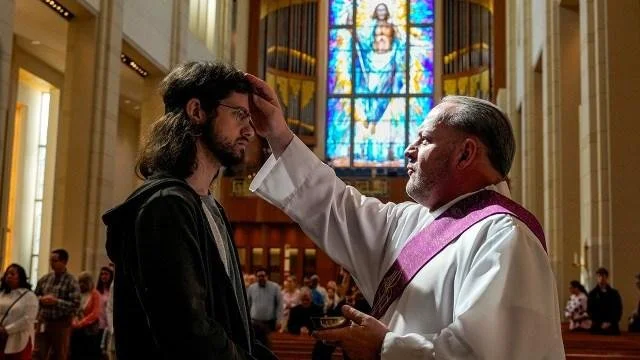
(A young Catholic receives ashes on Ash Wednesday at the Co-Cathedral of the Sacred Heart in Houston. | SOURCE: Raquel Natalicchio / Houston Chronicle)
Some political theorists have expressed skepticism that culture war issues actually matter to the electorate. The prevailing notion is that only the state of the economy and immigration really matter to moderate voters. This is patently false.
The most infamous example is the Trump campaign’s decision to run the “Kamala Harris is for they/them, Donald Trump is for you” ads. According to an analysis by Future Forward, Harris’s leading Super PAC, an astounding 2.7% of viewers changed to supporting Trump after viewing the ads.
To put that in perspective, Trump only won the popular vote by 1.8% in 2024. How many Trump votes that translated into is anyone’s guess, but even assuming a large margin of error, they surely had a significant impact.
Going forward, Democrats will continue to struggle with practicing Catholics unless they moderate significantly on these issues. However, the same phenomenon is likely happening to Trump that occurred with Democrats in 2024. It was easy for moderate practicing Catholics to conjecture that mass deportations were just campaign rhetoric. They couldn’t say the same for Harris on controversial issues, as she was a member of the Biden administration that had been executing socially liberal policies.
But now, the chaos of Trump’s economic and, particularly, his immigration policies has placed a target on his back. Just as the Biden administration’s violations of the Church’s teachings were in the limelight, Trump’s are as well. As moderate, practicing Catholic voters begin to despise the actions of the incumbent that are contradictory to their faith’s values, the other side begins to look more appealing. The governing party becomes repugnant to these moderate voters, who struggle to balance religious views that cross traditional party lines.
Is there crystal-clear polling data to support this? No. But summarizing the highly detailed factors that influence swing voters’ decisions is ridiculously difficult to do. When weighing the many pros and cons between two candidates they equally dislike, childhood memories from Sunday school could easily influence many moderate voters' choices.
As expected, Trump’s approval rating among Catholics and the public as a whole has plummeted. It is a mathematical certainty that some of these moderate Catholics are experiencing buyer’s remorse. The increasing brutality of Trump’s mass deportations of fellow Catholics is no doubt partially to blame, especially as the strength and appeal of the Vatican’s criticisms are only strengthened by Pope Leo’s nationality.
Will Catholics punish Republicans as they did Democrats for going too far on policies that contradict their values? Only time will tell. If Democrats want to convert them back into a loyal voting bloc, they will need to moderate considerably. Certainly, moderate practicing Catholics will be one of the most contested voting blocs going forward and will be essential in deciding who wins the White House in 2028.
The opinions expressed in this magazine are the authors’ own and do not reflect the official policy or position of The Spectator, or any students or other contributors associated with the magazine. It is the intention of The Spectator to promote student thought and civil discourse, and it is our hope to maintain that civility in all discussions.