
Curriculum Reform and Diversifying Faculty Hiring: A Necessary Reform in Higher Education
Curriculum Reform and Diversifying Faculty Hiring: A Necessary Reform in Higher Education
Washington and Lee and other universities should return to a more traditional course offering and intentionally diversify their faculty.
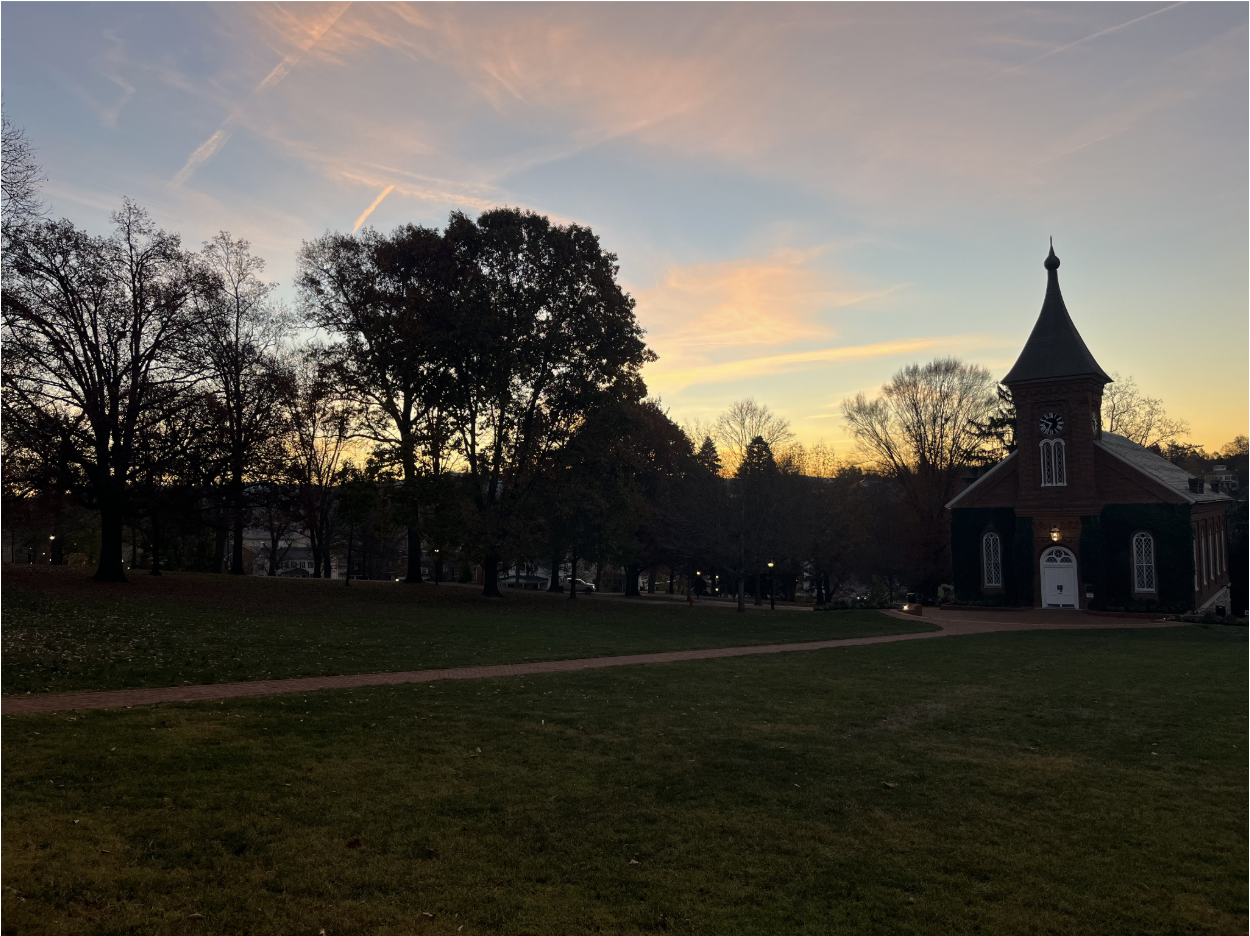
(Lee Chapel, National Historic Landmark, and the W&L Colonnade, at sunrise. | SOURCE: Alex Kagan ‘27)
“What should be taught?” and “who should teach it?”
For much of the 20th century, the answer to the first question was straightforward. The core curriculum of many universities consisted of English, history, math, science and languages. This was supplemented by courses in philosophy, religion, sociology and anthropology, art, music, politics, economics and other disciplines.
The predominant approach to teaching these subjects emanated from Western Civilization and the Judeo-Christian tradition. Even though professors were generally politically liberal, there was broad consensus on the basics of the American academic curriculum.
Trends beginning in the 1980s slowly changed this consensus.
Many of these developments were positive. For example, a diversified professoriate brought a wider range of experiences and perspectives to bear on what should be taught. More women and minorities were hired in the profession; more interdisciplinary fields were developed. Greater technology and more student input impacted what was taught.
At the same time, the professoriate began to lean increasingly leftward, with moderate and conservative voices being slowly erased. Post-modernism, post-colonialism, deconstructionism and critical race theory began their conquest of many campuses.
This meant that while racial, ethnic, and gender diversity increased, viewpoint diversity declined, giving way to a kind of homogeneous “groupthink” at many institutions.
Since the early 21st century, a healthy appreciation for the culture and heritage of minority groups has been transformed into a counterproductive obsession with group identity. The new ideology denies that members of different groups can truly understand one another and insists that institutions should treat people based on their extrinsic characteristics.
This approach rejects universal truth, traditional moral and religious behavior, and broader dialogue among different groups. It is divisive, repressive and destructive of differing viewpoints.
One of the ways that this approach manifests itself is in mandatory diversity training for students and required diversity statements for faculty. This tends to weed out moderates, libertarians and conservatives who oppose this forced conformity.
This approach also asserts itself in the new curriculum offerings, many of which are based on identities such as race, ethnicity, gender, sexual orientation, and disability. W&L has not been immune from these developments.
In 2018, I wrote an article titled “Dumbing Down the Curriculum” where I pointed out that several new courses seemed to be of dubious academic or practical value, appeared to espouse a particular political agenda, and/or were simply trivial. I identified about 20 courses in the University Catalog that fit this description.
Many of these courses seemed to reflect the ever-narrowing and increasingly politicized specializations of professors, fueled by graduate schools that encourage this approach to knowledge and research interests.
I advocated for a discussion of curricular issues in the W&L community and suggested that a broader approach to the curriculum could encompass many of these topics without devoting entire courses or, in some cases, creating departments to nurture these highly specialized areas.
In the seven years since I wrote this article, the situation has only gotten worse. In the fall of 2025, The Generals Redoubt identified approximately 70 identity-based courses that had been taught since the fall of 2023. The courses were spread across 14 undergraduate departments.
The largest numbers are offered by the Departments of History, English, Sociology and Anthropology, as well as Religion. Several of these courses seem duplicative or overlapping. For example, there are several courses on African Americans in the arts.
Other courses appear to be under a questionable rubric or department. Why should courses in “Inequality and Fair Opportunity” or “Poverty, Oppression, and Privilege” be in the Philosophy Department rather than in, say, the Sociology Department?
Additionally, there are the courses that simply do not belong in a quality liberal arts college. Why do we need a course on “Belonging in College”?
Some of the courses seem very well attended, while others have very few students.
What is clear is that there appears to have been no overall examination of the W&L curriculum: its pertinence, usefulness or academic rigor. It appears there has been simply a proliferation of courses based on the professor’s interests or political ideology.
What is needed is a curriculum based on universal human values. One that promotes a comprehensive educational experience and prepares students for diverse societal interactions, and one that encourages discussion and debate and helps prevent ideological homogeneity.
This new paradigm will include insights gleaned from diverse minority groups, but it will also stress common values across all groups. It will include a balanced approach to Western Civilization and American studies, rather than the unrelentingly negative view that is so prevalent today.
As far as W&L is concerned, there are several suggestions:
Determine whether certain departments or areas of study are even necessary. Could not “Africana Studies” be folded into the History and English Department? Why not include “Women and Gender Studies” in the Sociology/Anthropology Department?
Examine courses that appear duplicative or have poor attendance. Consolidation of areas of study and courses would invigorate a broader approach to the curriculum.
Return to a curriculum based on chronology, geography and biography. A course in “20th Century American Literature” would, of course, include authors from many different groups, but would have the advantage of being broader in scope and would invite comparisons of authors from different groups.
Promote courses or even centers in civics and government. This is happening at many colleges and universities, both public and private, across the country.
Develop a minor in an area such as “Civic Leadership and Public Humanities.” The University of Pennsylvania is currently working on such a course of study.
Develop some courses on conservative thought and history. There has been an interplay between conservative, libertarian and liberal principles throughout the history of the West and of America.
Consider requiring introductory courses in philosophy, English literature, religion, American history and civics.
Introduce a course or courses based on the great books of the Western tradition. The University of Chicago and St. John’s College have led in this area.
Work on the development of programming that promotes debate and discussion of issues from a variety of viewpoints. There is currently an initiative underway at W&L to accomplish this.
If Washington and Lee is going to reform its curriculum, it will require leadership at several levels.
The Board of Trustees will have to recognize this need and hire a president to address it. The provost and other administrators will have to be part of the process, as will the faculty.
Initially, some faculty may well resist these changes, but their opinions will certainly need to be sought. However, the faculty must not be allowed to have total control over the curriculum.
One of the critical sources of input will have to be the students themselves. The administration should conduct student surveys to determine which courses they consider important and useful for their future. Parents and alumni should also have a say.
But who will teach this reformed curriculum? Here, we are dealing with the issue of faculty hiring and, in some cases, re-training. Current faculty may need to move somewhat away from their narrow focus on identity issues and embrace a broader curriculum.
In many cases, this can be done within broader courses. They will still be able to incorporate identity studies in their teaching, but within the framework of a more inclusive, academically rigorous, and pragmatic curriculum.
Hiring new faculty to teach the adjusted curriculum will be a long-term task. Currently, there are simply not enough potential professors educated in the curriculum I have described. Still, some strategies could be employed to increase faculty viewpoint diversity and identify those who could teach the new curriculum:
Enter a conversation with universities that have attempted to promote viewpoint diversity and a broad, pragmatic, core curriculum. Examples include St. John’s College, the University of Chicago and Notre Dame.
Examine the tenure process not for its elimination, but for ways it might be reformed. A heavy reliance on tenure may limit a college’s ability to attract new talent and diverse viewpoints, or to respond to market conditions. Some suggestions include encouraging early retirement, raising tenure standards and extending the probationary period before tenure is granted.
Recognize the severe lack of moderate, libertarian, and conservative voices among the faculty and embrace the crucial importance of these voices to true viewpoint diversity. Create chairs in subject areas that will attract such people. An example would be the “Milton Friedman Chair of Economics.”
Encourage conservative, libertarian and otherwise heterodox students to pursue careers in higher education. A model for this type of program exists at Johns Hopkins University.
Create courses or a center in civics and government to attract potential professors with a broader intellectual background.
Encourage professors to join groups such as the Heterodox Academy (HXA) and the Foundation for Individual Rights and Expression (F.I.R.E.), which promote freedom of expression, civil discourse, and viewpoint diversity.
Eliminate diversity statements as a hiring condition.
Either eliminate the D.E.I. initiatives or have the Student Engagement and Leadership department include viewpoint diversity among its responsibilities.
Involve the President and Provost more in faculty hiring. Faculty should not be the sole gatekeepers of faculty hiring.
Inform the Trustees on the importance of a curriculum revision that will better prepare students for life leadership in a fast-paced world.
Winston Churchill once said of democracy that it “is the worst form of government except for all those other forms that have been tried.” Fortunately, W&L has not gone down the road of some of the more radical and politically correct colleges and universities in our country.
Our institution is still a fine liberal arts institution that prepares its graduates for the modern world.
We do not wish the university to be forced to make changes by outside entities, such as the federal or state government. What we desire is internal reform when necessary, and we wish to see buy-in from all constituencies — trustees, the administration, faculty, students, parents and alumni. Numerous alumni are ready to support the university in this process.
The opinions expressed in this magazine are the authors’ own and do not reflect the official policy or position of The Spectator, or any students or other contributors associated with the magazine. It is the intention of The Spectator to promote student thought and civil discourse, and it is our hope to maintain that civility in all discussions.