
Board of Trustees Rector Discusses W&L’s Goals and Prospects
Mr. Wangdali Bacdayan reflects on his experiences at W&L and comments on the presidential search.
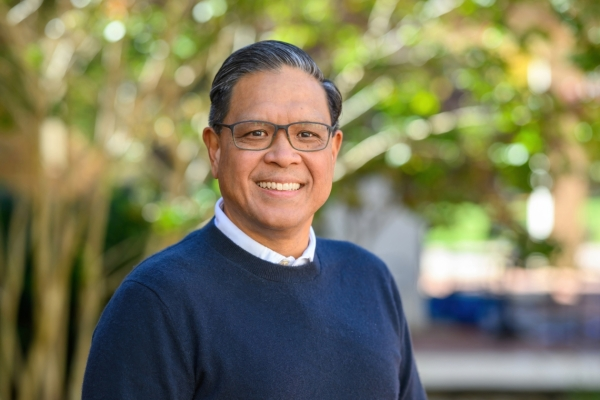
(Wangdali “Wali” C. Bacdayan,‘92, Rector of the W&L Board of Trustees. | SOURCE: The Columns)
(Note: This interview occurred in spring of the 2025-2026 academic year)
Washington and Lee University “has a tremendous history behind it,” Rector Wangdali “Wali” C. Bacdayan noted, adding, “the university is much larger than any one individual, any one leader.”
The Spectator sat down with Bacdayan, ‘92, the rector of the Washington and Lee Board of Trustees, to discuss his experiences at W&L, the presidential search, and the university’s future.
Originally from Natchitoches, Louisiana, Bacdayan’s decision to attend was heavily influenced by word-of-mouth and “the financial aid package” offered to him. Having only begun admitting women in 1985, Bacdayan’s freshman year was the first time female students had attended for a full four years.
Bacdayan’s four years in Lexington were not the end of his W&L journey, staying connected with the W&L community ever since, including with all the university’s presidents since John D. Wilson, who served as president from 1983 to 1995.
Outside of W&L, Bacdayan has built a career in private equity, calling it “a valuable experience.” “[It] gives you a perspective on what it is like to lead a multi-constituent organization,” he noted.
In terms of his experience with the W&L Board of Trustees, Bacdayan understands the large responsibility that this position entails. He said that he’s “charged ultimately with leading a university that serves many constituents.”
Regarding the makeup of the Board of Trustees, he said, “We have a very diverse set of backgrounds on the board.” Board members possess professional experience in academia, business, medicine, governmental affairs and other fields. Bacdayan said the Board strives to craft a board composition that enables people to serve as internal resources for one another.
Bacdayan’s tenure on the Board, which he has served on since 2019, occurred during President Will Dudley’s tenure. Pondering President Dudley’s legacy following his decision to leave W&L at the end of the academic year, Bacdayan reflected that “making Washington and Lee need-blind is a tremendous accomplishment” that is “notable in the landscape of higher education.”
Bacdayan noted that President Dudley has a bright future and showed his gratitude to Dudley for his work at W&L. “We are very grateful to Will for his leadership,” he said, noting that Claremont McKenna College, from where Bacdayan’s oldest son graduated, is a “wonderful institution.”
The goal of W&L, Bacdayan argued, is to “select and admit the most accomplished students” possible. When it comes to accomplishing this, Bacdayan hopes that a student’s “ability to pay” will cease to play a significant role in admissions. Bacdayan thanked W&L alumnus William “Bill” Miller III, ‘72, for helping to realize this goal, saying, “We can’t thank Bill enough for such a transformative gift.”
Regarding his contributions to the school’s policy, Bacdayan noted that after joining the Board in 2019, the body had to “navigate a very rocky social and political time.” He remembered that it was “not always easy to sort through,” something he argued President Dudley experienced as well, who “gets a lot of the attention for things that happened that were outside of his control.”
One of these contentious issues was the question of the name change: “We handled it pretty well,” Bacdayan reflected.
Commenting on the Master Plan, Bacdayan said, “The next president will have to come and see,” if they “agree with those initiatives.” He asserted that W&L was planning on moving ahead with those projects. “We are not putting those things on hold,” although he qualified that “some of that will depend on the completion of the capital campaign,” and that “these are not necessarily priorities of one individual specifically.”
When it comes to the presidential search, Bacdayan said, “The selection of the new president is … maybe the most important thing that the Board does.” When asked what the Board is looking for in a new president, he said they were asking themselves, “What are the needs of the university looking forward?”
He emphasized how important participation was from those outside of the board. “Students, faculty, staff and alumni should all get to contribute in framing and identifying what we need in the next president.” He stated that it’s “very natural to have leadership transitions” but that “ultimately getting the choice right is more important.”
On the potential need for an interim president, Bacdayan said the university was “fortunate that we have Will with us through graduation.” Whether the next president is an alumnus will be “determined by the pool of candidates.” “Finding somebody that is either familiar with the institution or has a connection… would be important,” he said.
“We haven’t gone through the definitional phase in the search process.” He also added that the board “has received calls to consider ‘non-traditional candidates.’” The board’s goal of understanding what it is that the community wants “kick[ed] … off in January.”
When asked whether polls could be used to gauge the community’s desires, Bacdayan said, “all of those things are tools and tactics that will be employed.” Explaining why the board is not sharing more information, he said, it’s “unusual for private universities to make the pool of candidates known.”
“The sensitivity in candidates’ interest in our position relative to their employment” is “very complicated” and “risky” for them to “have that interest known,” especially for those in “positions of significant leadership.”
In describing the role of the President, Bacdayan said that “they sit at the hub of all of the things happening.” The board must ask itself in the search “what are those needs and priorities” of W&L’s “unique community.” He noted that the school needs “someone who understands the passion and devotion” of various community members.
Bacdayan said that W&L is in a “relatively quiet period.” “We don't have the same exposure” to controversies as “an R1 research institution,” noting that we “don’t rely heavily on federal grants or monies.”
The Honor System also came up in relation to the search. “As we have spoken to different search firms, an appreciation and understanding of the Honor System has been a top priority we have tried to convey to search firms.” Bacdayan pledged that the Board “will certainly speak with students, faculty, alumni, staff about the importance of things like the Honor System.”
He argued that this unique aspect of W&L unifies the board. “We have talked about the Honor System at the Board level; it’s one issue that spans constituent groups,” he noted. W&L’s goals should not be “only … to educate,” but to inculcate “the concept of character,” he said. “That is the unique aspect of Washington and Lee: we are going to the point of character,” Bacdayan said, adding, “We are making a statement about who we are.”
Speaking on other W&L traditions, Bacdayan said that the Honor System, Speaking Tradition and Greek life were all important for him at W&L. The “Speaking Tradition is a very unique aspect of Washington and Lee,” he said, adding that these traditions contribute to why he thinks “W&L from a student perspective is far and away and consistently at the top of whatever peers you are looking at.”