
No, It’s Not “Trump’s Court”
The Roberts Court is not “made in Trump’s image”; it simply upholds tradition.
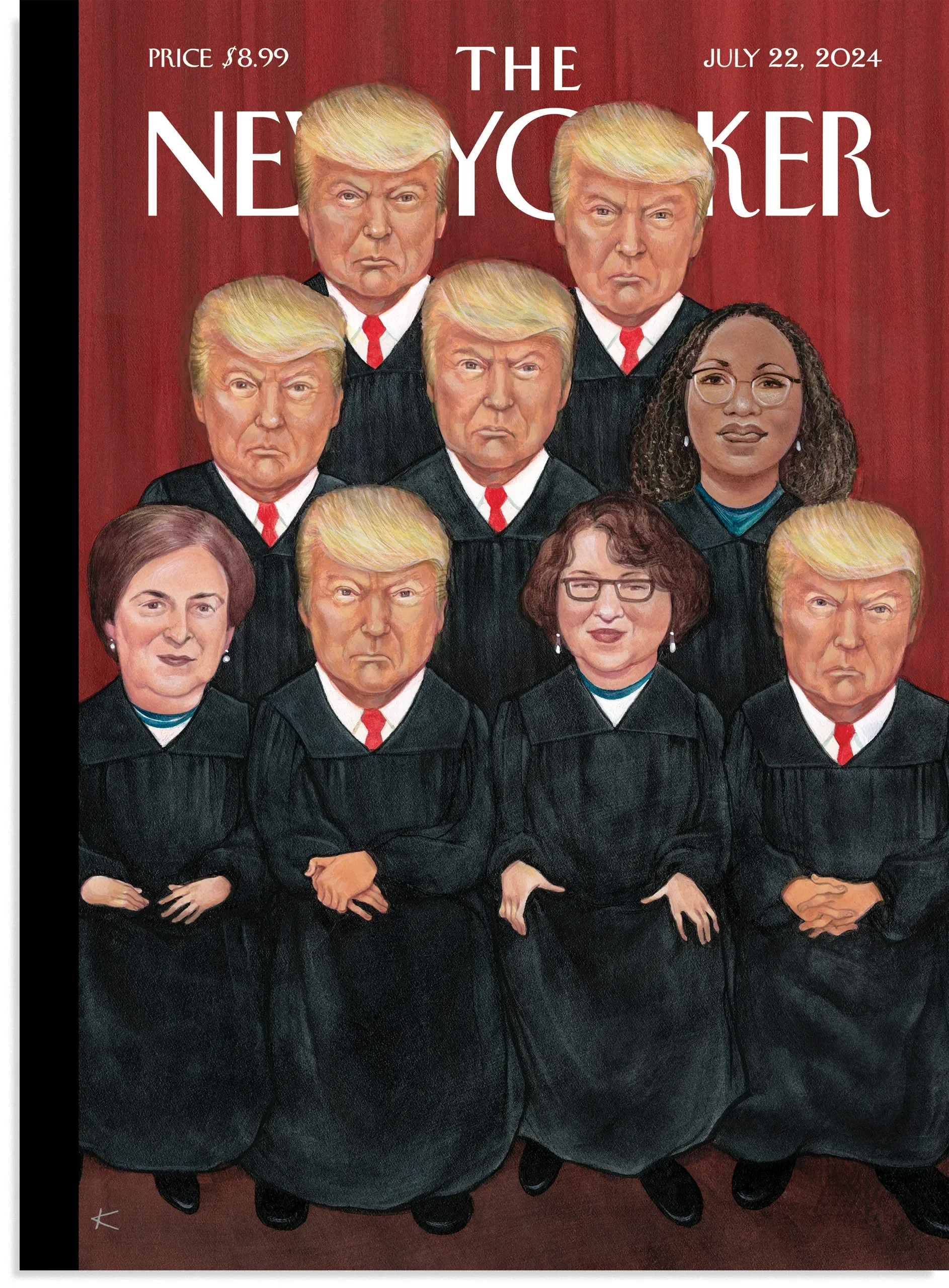
(The Face of Justice Cartoon | SOURCE: Anita Kunz)
In July of 2024, The New Yorker published a piece titled “The Face of Justice: The remaking of the Supreme Court in Donald Trump’s image.” The article featured a political cartoon by Anita Kunz depicting the six conservative justices with Trump’s face, whereas Jackson, Kagan and Sotomayor appeared as their usual selves.
Although Kunz is correct in pointing out the 6-3 conservative majority, conservatism and Trumpism are not the same ideology. Rather than forgoing the constitutional canon in favor of Trump’s agenda, the current Court abides by a traditional view akin to Antonin Scalia. The Roberts Court adheres to originalism, not Trump.
On September 16, 2026, Washington and Lee hosted a Constitutional Day panel of undergraduate and law faculty members that reviewed the impacts of the Supreme Court’s decisions in 2025-2026. Two of the cases discussed, Louisiana v. Callais (2026) and Learning Resources, Inc. v. Trump (2026), demonstrate the key differences between the Trump administration and the current Roberts Court. Louisiana struck down a majority-minority district map and strictly narrowed the provisions of Section II of the Voting Rights Act of 1965 (VRA).
The plaintiffs argued that the newly drawn boundaries of Louisiana’s 6th Congressional District, a majority-minority area, violated the 14th Amendment’s Equal Protection Clause on account of race-based discrimination. In a 6-3 ruling, Justice Alito opined that a “compelling government interest” is required for race-based gerrymandering to not violate the 14th Amendment. Alito argued that, since the VRA doesn’t require majority-minority districts, there is no compelling government interest. Furthermore, the standard to examine whether a compelling interest exists ought to be “strict scrutiny” in finding instances of intentional discrimination, as outlined in Section II of the VRA.
Therefore, the lack of majority-minority districts was determined not to be intentional discrimination, meaning there existed no compelling government interest to create one, making the district map unconstitutional.
President Trump reacted positively to this conservative ruling, posting on TruthSocial, “Today’s 6-3 Supreme Court decision in the Callais case is a BIG WIN for Equal Protection under the law, as it returns the Voting Rights Act to its Original Intent, which was to protect against Intentional Racial Discrimination.” While Trump agreed with the Louisiana ruling as it pertains to race-based gerrymandering, he has previously expressed support for gerrymandering that favors fellow Republicans.
In a POLITICO piece from August 2025, Trump advocated for the proposed district map in Texas, stating Republicans were entitled to “five more seats.” Although a District Court ruled in November that the map constituted a racial gerrymander, Trump supported it until its passing. Thus, whereas Alito’s opinion grounded itself in the 14th Amendment, Trump preferred what was best for him and his party. It just so happened that these perspectives aligned in Louisiana.
While Trump and the Roberts Court agreed in Louisiana, that was certainly not the case in Learning Resources, Inc. v. Trump. The case originated from Trump’s tariff policies near the beginning of his term, wherein he declared national emergencies on illegal drugs and trade deficits affecting manufacturing and supply chains.
While Trump and his counsel argued that the International Emergency Economic Powers Act (IEEPA) authorized his sweeping tariffs, the Roberts Court disagreed, ruling that the power to impose tariffs is exclusively enumerated to Congress in Article II and not among the powers granted to the President in the IEEPA. Even if there were an “unusual and extraordinary threat,” the IEEPA only grants the President the authority to “regulate the importation” of goods, not to lay taxes and levies on other countries.
Thus, Trump’s tariffs followed neither the IEEPA nor the original intent of Article II, and Roberts struck them down.
These two cases, and Trump’s subsequent reaction to them, highlight a unique element of Trump’s presidency: a lack of consistent ideology. While Trump’s policies may lean conservative, they do not form a comprehensive system of constitutional interpretation. Trump may support the original intent of the Roberts Court in Louisiana and despise it in Learning Resources, depending on how it affects his administration.
By this measure, the Court can never be “Trump’s Court,” unless the six conservative justices decide to forgo their judicial ideology in pursuit of Trump’s personal agenda. This is apparent when comparing Louisiana and Learning Resources; the Roberts Court consistently ruled in favor of original intent, while Trump opined in favor of his party.
The current Supreme Court is certainly conservative, but it is not made “in Trump’s image.” If anything, Kunz should have depicted Scalia’s face on the conservative majority, not Trump’s.
The opinions expressed in this magazine are the authors’ own and do not reflect the official policy or position of The Spectator, or any students or other contributors associated with the magazine. It is the intention of The Spectator to promote student thought and civil discourse, and it is our hope to maintain that civility in all discussions.