
W&L Faculty Pay Declines Relative to Peer Institutions
W&L Faculty Pay Declines Relative to Peer Institutions
W&L experiences declining faculty pay compared to peer institutions, but still outperforms with cost of living adjustments.
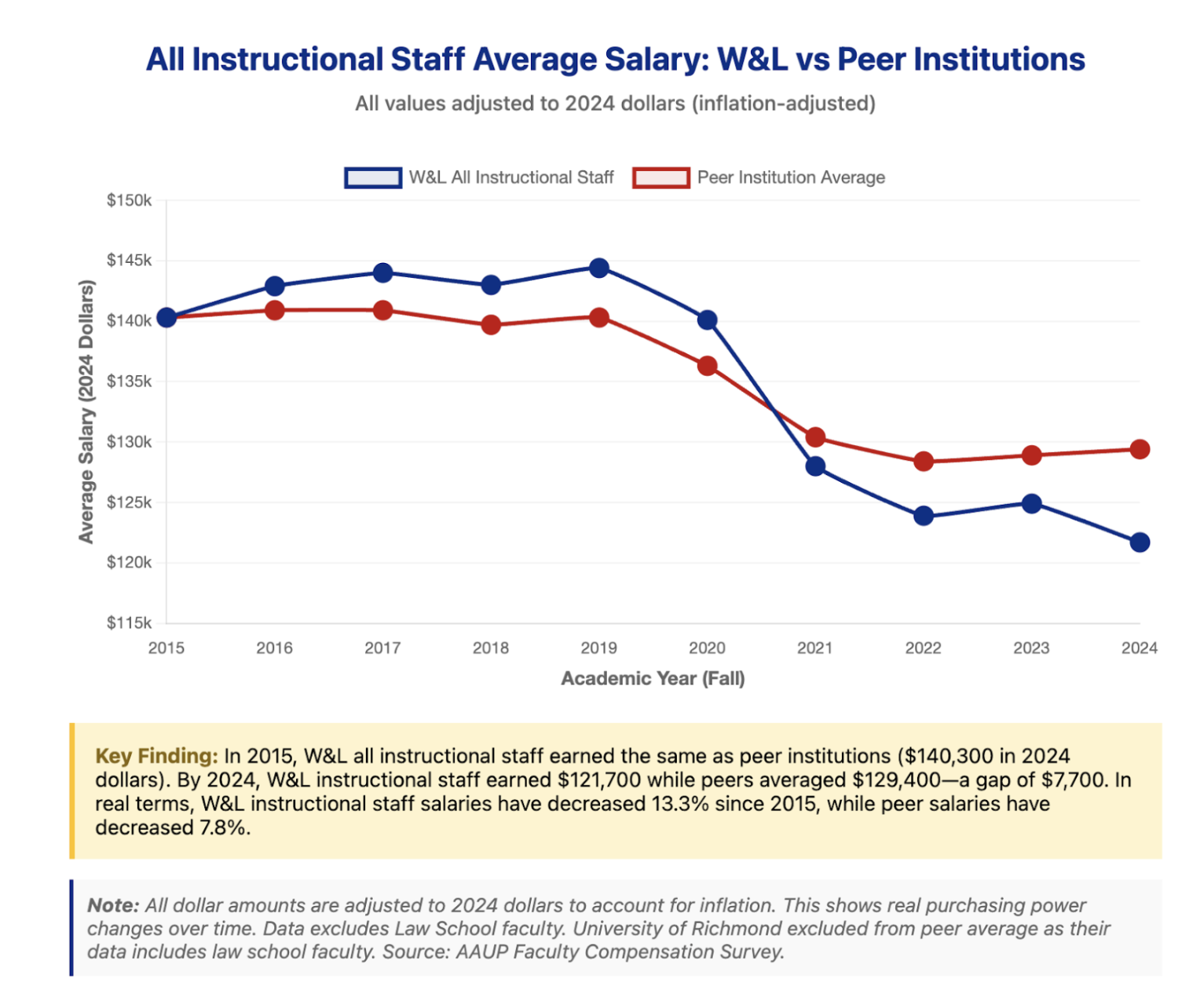
(All instructional staff Average salary: W&L vs peer institutions. | SOURCE: AAUP ); Graph created by The Spectator using W&L’s list of self-described peer institutions.
Compensation for W&L faculty has decreased relative to peer institutions since 2016, data from the American Association of University Professors (AAUP) reveals. Still, according to an analysis by W&L’s Human Resources Department, reviewed by The Spectator, faculty pay exceeds that of peer institutions when the cost of living is accounted for.
In 2015, W&L faculty earned approximately the same salaries as faculty at peer institutions. By 2024, they earned an average of $7,700 less. Overall, due to below-inflation raises, inflation-adjusted salaries for faculty fell by an average of $18,600 between 2015 and 2024 at W&L. W&L paid faculty higher salaries than peers prior to the economic uncertainty of the early 2020s.
Journalism professor Toni Locy, in an interview with The Spectator, expressed discontent with the recent raises that faculty have seen. “We were told … that you have to take a hit during Covid, but we’ll give it back to you. And they never gave it back to us,” Locy said.
In recent years, while relative professor pay has declined, W&L has consistently exceeded fundraising goals. In addition to regular fundraising, the university received $132 million from Bill Miller, ‘72, to support need-blind admissions and an additional $30 million from an anonymous donor to build a new facility for admissions, financial aid and other administrative staff.
In raw terms, W&L now pays faculty less than peer institutions on average. Despite this fact, according to a university analysis based on data from the Council for Community & Economic Research’s Cost of Living Index, W&L faculty still hold a buying-power advantage over their peers at similar institutions after cost of living is accounted for.
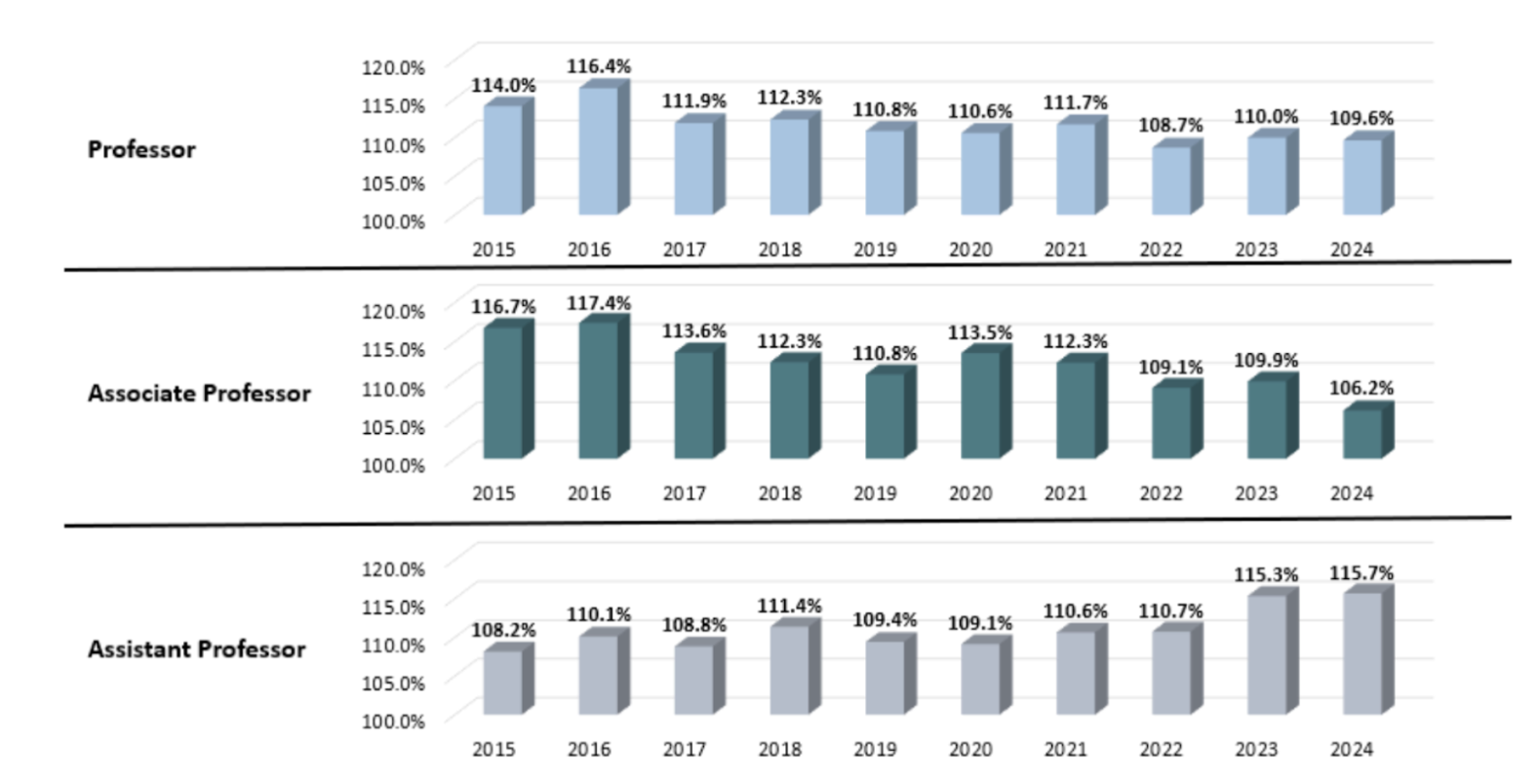
(Undergraduate faculty pay as a percentage of top-25 liberal art school’s median, adjusted for cost of living. | SOURCE: W&L Human Resources); Since not all W&L Professors live in Lexington, multiple locations are weighted for this analysis; Lexington’s cost of living score was weighted at 50%, Roanoke’s at 25%, and Charlottesville’s at 25% due to faculty living in those areas to determine the overall W&L faculty cost of living score; The data excludes accounting, finance, and business administration faculty since they are not present in some top-25 institutions; The data is limited to tenure and tenure-track faculty.
Approximately 70% of W&L’s annual operating budget is spent on compensation. “What we provide is a people-focused business,” Jodi Williams, the Executive Director of Human Resources at W&L, told The Spectator in an interview.
Williams, who has worked in compensation and other Human Resources roles at W&L for over a decade and a half, emphasized that it is “important to not look at a blip” when examining faculty compensation. Salary raises provided to W&L faculty regularly kept pace with or exceeded inflation until the Covid-era uncertainty led to industry-wide salary stagnation. Professors who have spent their careers at W&L, Williams highlighted, received salary growth well above inflation.
The total salary increase pool for the 2025-26 academic year, applied in July 2025, was 2.5%. According to salary letters sent to faculty, the school distributed a “base increase” of 2% to faculty who performed well and awarded the remaining budget according to merit across teaching, scholarship, creative work and academic service. The total pools for previous years, according to Williams, were 3.5% in the 2024-25 academic year, 3% in 2023-24, 6% in 2022-23, 1.5% in 2021-22 and 0% in 2020-21, due to Covid-related difficulties.
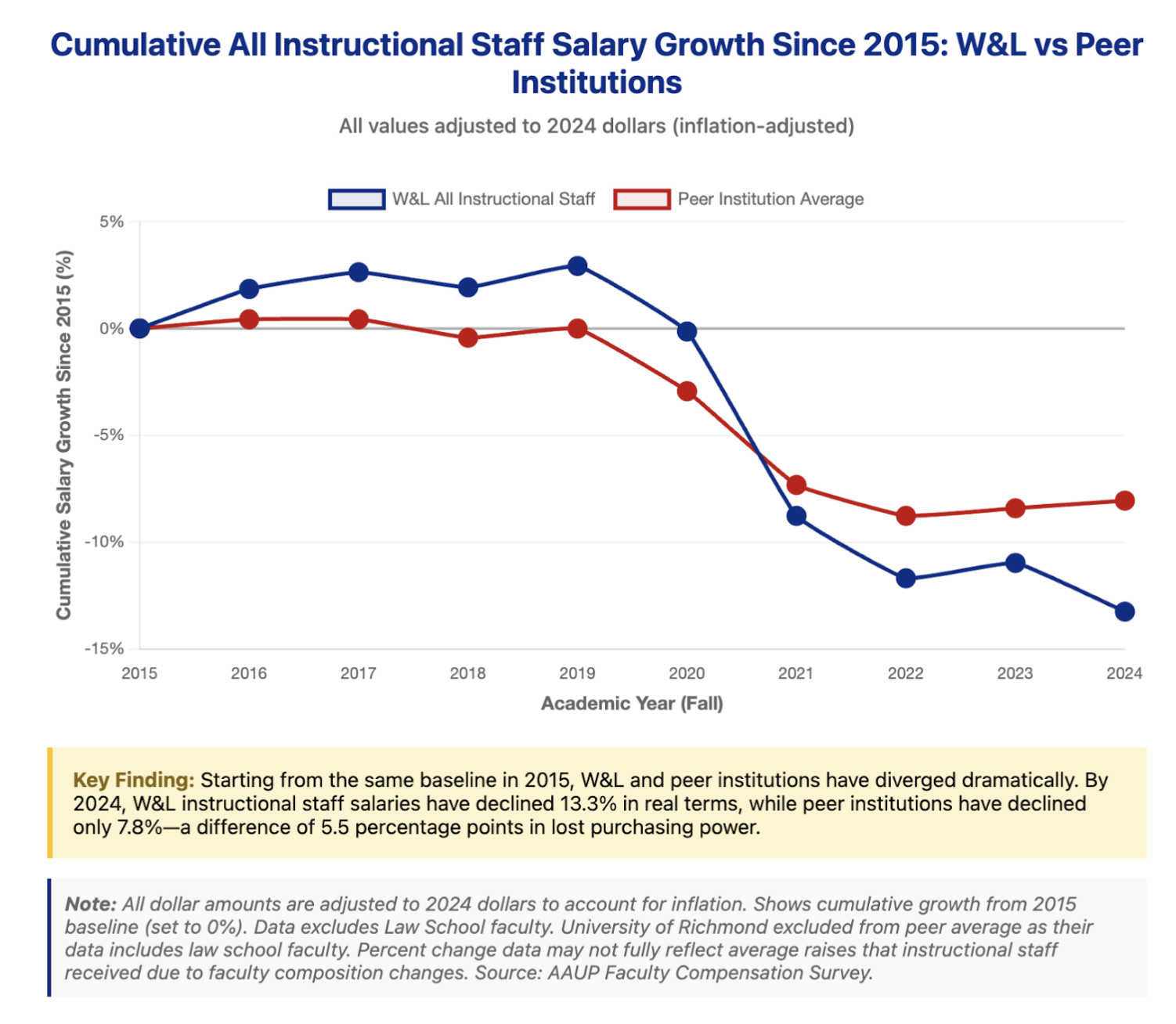
(Cumulative instructional staff salary growth since 2015: W&L vs. peer institutions. | SOURCE: AAUP); Graph created by The Spectator using W&L’s list of self-described peer institutions.
The 6% salary pool increase in the 2022-23 academic year was provided because the Board of Trustees “wanted to do something for our people” after the Covid-era difficulties, according to Williams.
Williams added that W&L is closest to meeting the average market salary for the assistant professor position, saying that attracting strong Assistant Professor faculty with market competitive pay is a strong focus. W&L trails further behind in full professor salaries.
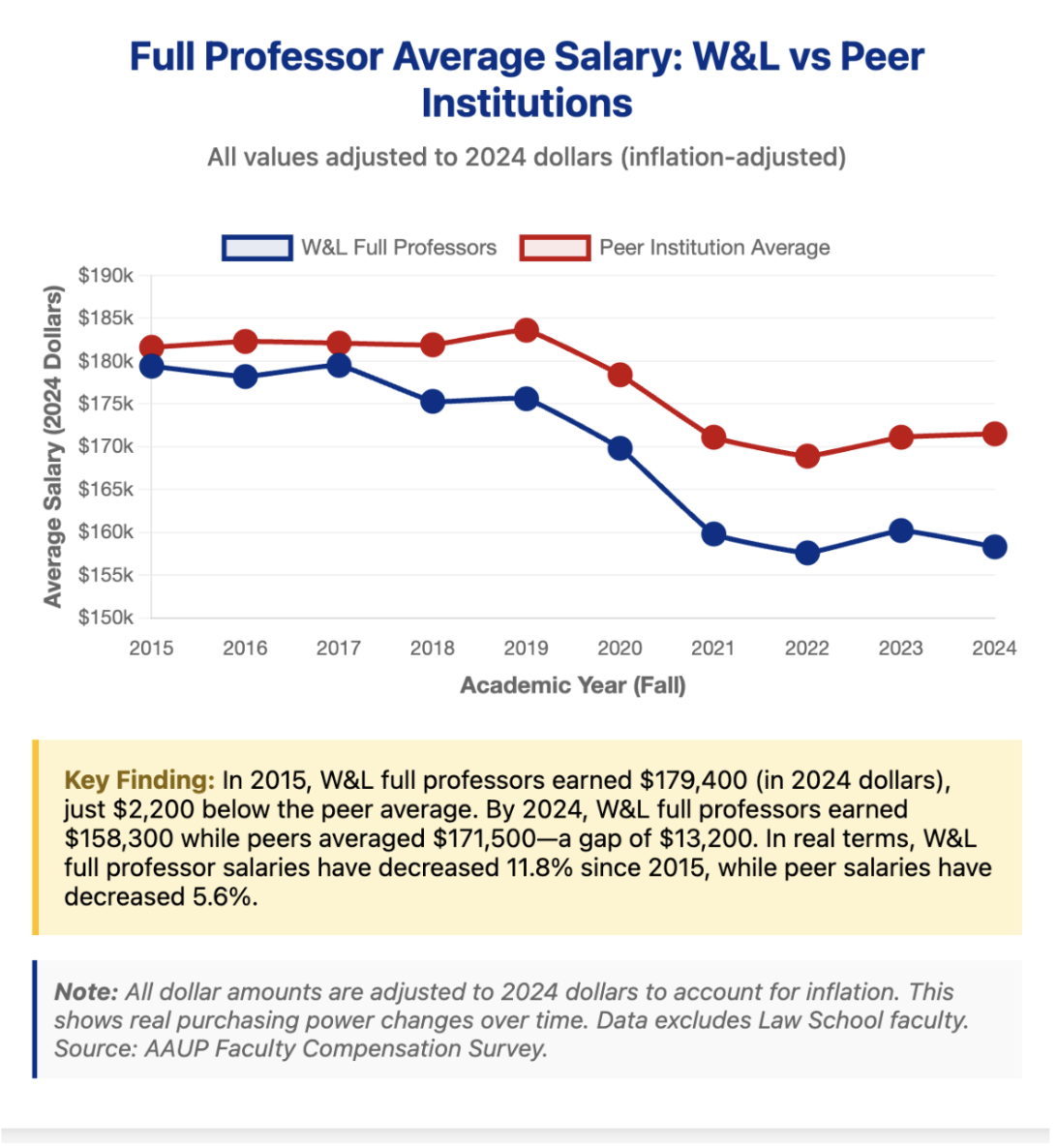
(Full Professor Average Salary: W&L vs Peer Institutions. | SOURCE: AAUP); Graph created by The Spectator using W&L’s list of self-described peer institutions; Note: Data prior to 2015 was unavailable to The Spectator.
In addition to their base salary, faculty can apply for the Lenfest Grant, which pays a $4500 stipend to conduct research over the summer in addition to $2000 of expense reimbursement. According to a W&L professor who spoke with The Spectator, this rate has not been adjusted for inflation since they came to the university. At research institutions, the standard rate for summer research is between 2/9ths and 3/9ths of a professor’s annual salary, or approximately $27,000-40,000 for the average W&L faculty member (AAUP). Faculty summer research income varies among liberal arts institutions. Amherst, a W&L peer institution, caps grant-funded summary salary of 3/9ths of a professor’s annual pay. The University of Richmond, another peer, provides a $6000 stipend for faculty summer research fellowships.
Impact on Professors & Recruitment
According to Locy, this decrease in relative salary has been accompanied by an increase in responsibilities. “The vibe here is different … they’re throwing crumbs at us while we are asked to do more and more.”
Faculty, Locy emphasized, feel that their jobs are expanding to include additional department committee work, university committee work and other responsibilities. “We’re not just in a classroom … there’s more and more of it every year,” she said.
Locy is not the only discontented faculty member. According to an anonymous W&L professor who spoke with The Spectator, a colleague circulated an email to faculty, hoping to discuss low salary pool raises and potentially take action. That said, the professor who spoke to The Spectator was not aware of any action ultimately taken by the group or the professor who sent the email. “I think people have made peace,” the professor added.
Professors interviewed by The Spectator expressed concern about how declining comparative pay could impact recruitment efforts. “I’ve been on search committees,” Locy told The Spectator. “It is harder than hell to get people to want to come to Lexington… in this department alone we have had failed searches.” “You have to give money,” Locy added. “That’s how you attract people.”
Cost Saving Measures
According to Williams, the university has also taken a number of measures to slow the salary budget’s growth. These include retirement incentives and the creation of a committee to review staff and administrative positions as they become vacant “for possible replacement, closure or reclassification of role.”
In the summer of 2025, W&L offered eligible faculty retirement packages equal to 6-months of pay to create salary budgetary savings from the retirement of the highest-paid professors. Williams told The Spectator that she received a “positive response” from faculty who decided to accept the package, adding that she “got hugs from many people.”
Professor Locy had a different interpretation of this retirement package. “Failing newspapers give better buyouts than we did,” she said.
“These efforts are all focused on slowing the growth in the salary budget, hopefully in a manner that does not negatively impact our current employees,” Williams told The Spectator.
Endowment Underperformance
One factor behind a more restricted budget has been W&L’s recent endowment underperformance. According to the Ring-Tum-Phi, W&L has failed to meet its endowment return goals for the last three years. The endowment returned only 1.8% in 2022-23, the same year faculty received a 6% raise. It gave a return of -6.6% the year before. Williams, who described W&L’s recent endowment performance as “not good,” added that other universities have struggled in similar ways.
“People take money personally,” Locy told The Spectator. “When we get those letters about what the salary pool is going to be, it’s like we’re competing for crumbs.”
“It conveys an aggressive disrespect for faculty,” Locy said.