
W&L Community Reacts to Law Student’s Sexual Assault Conviction
Tate Weston, a former W&L Law student, was admitted despite misconduct, raising questions and prompting calls for the resignations of Law School leadership.
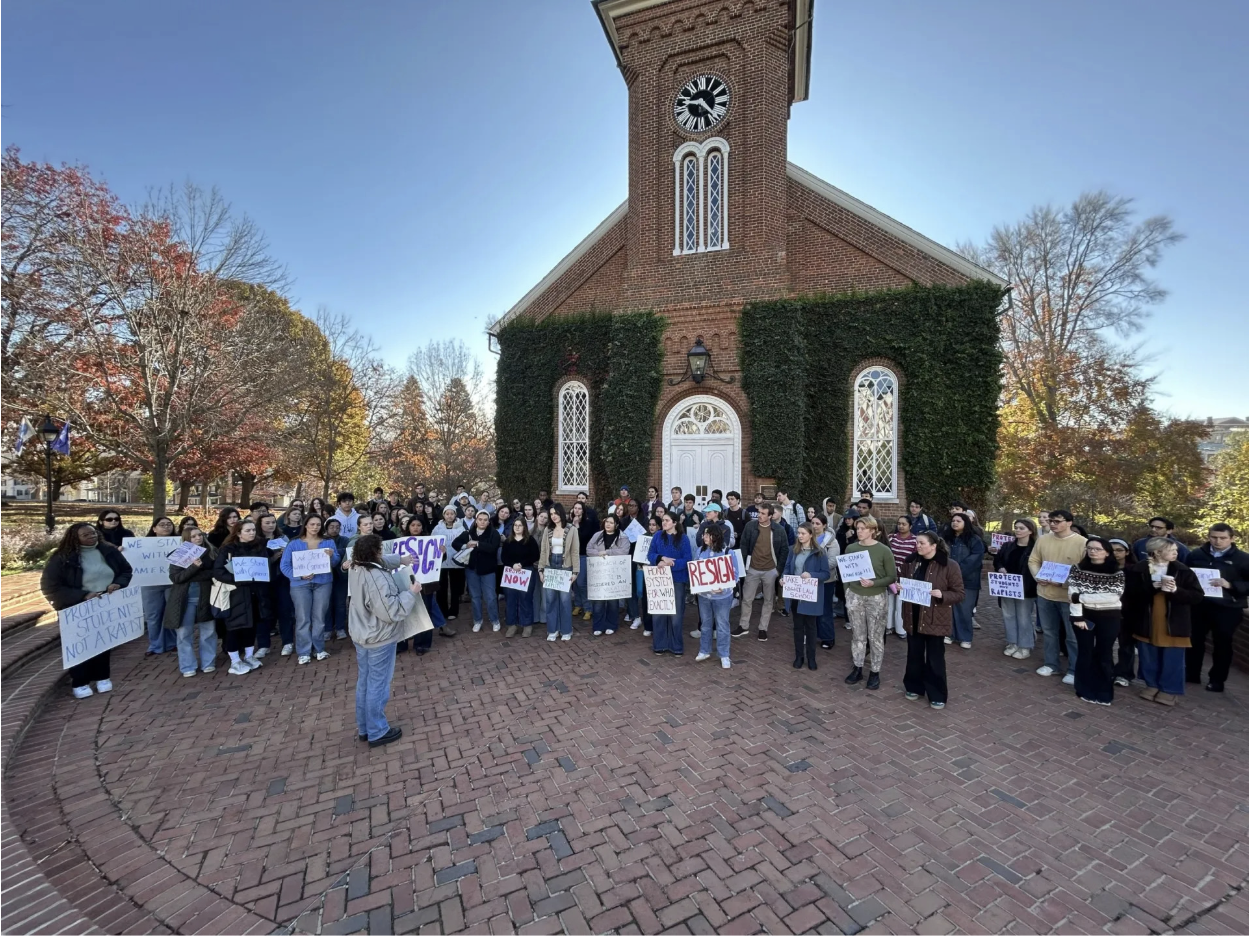
(W&L Law students protesting outside of Lee Chapel, National Historic Landmark, on November 16. | SOURCE: Laura Powers)
Mid-November saw the Washington and Lee School of Law community reeling from a shock within its student body: a law student convicted of sexual assault from before his time at W&L, raising questions about admissions practices and the future of several W&L administrators.
On Monday, November 16th, The Washington Post reported that Tate Weston, a now-former W&L third-year law student, pleaded guilty to multiple violent crimes committed during his time as an undergraduate at Tulane University.
Weston “pleaded guilty to second-degree battery, a felony, and misdemeanor sexual battery, as part of a deal with prosecutors in New Orleans,” stemming from an incident that occurred on September 21, 2021.
This conviction was the result of a years-long process for Weston following his assault of a fellow Tulane student. By May, 2022, at the latest, New Orleans Police were investigating Weston for the incident.
Tulane would ultimately find Weston “responsible for the sexual assault and recommended expulsion.” Yet, despite Tulane’s assurance to his victim that Weston would not graduate, Tulane awarded Weston a diploma after he earned credits from a state university in Texas.
Despite these personal conduct issues, in 2024, W&L Law admitted Weston as a member of the Law Class of 2027 without acknowledging his history to fellow students or faculty. His legal issues, first revealed to the W&L community by The Post’s story, sent shockwaves and also revealed that he had been criminally charged for his actions in December 2025, during his 2L year.
In the face of intense backlash, Tate Weston has unenrolled from W&L Law, although it is unclear whether he was formally expelled or has withdrawn.
Law School administrators have been placed under intense scrutiny after The Post’s revelation that “admissions staff were aware when Weston applied that he had a misconduct finding at Tulane, but said they did not conduct any ‘additional inquiry.’” This reporting was later confirmed by Peter Jetton, W&L Law’s associate dean of communications and marketing strategy, although the administration notified W&L Public Safety about his history of misconduct.
Additionally, Weston’s victim had been in contact with W&L Law administrators as far back as November of 2024, Weston’s first semester.
After the article’s release, W&L Law students staged a protest to express their outrage with the administration’s handling of the situation, marching from the Law School and continuing across campus until they reached Interim President Ruscio’s office and Lee Chapel.
Additionally, students in a criminal procedure class taught by W&L Law Dean Melanie Wilson staged a walkout the day after the story’s release, with the vast majority of students participating.
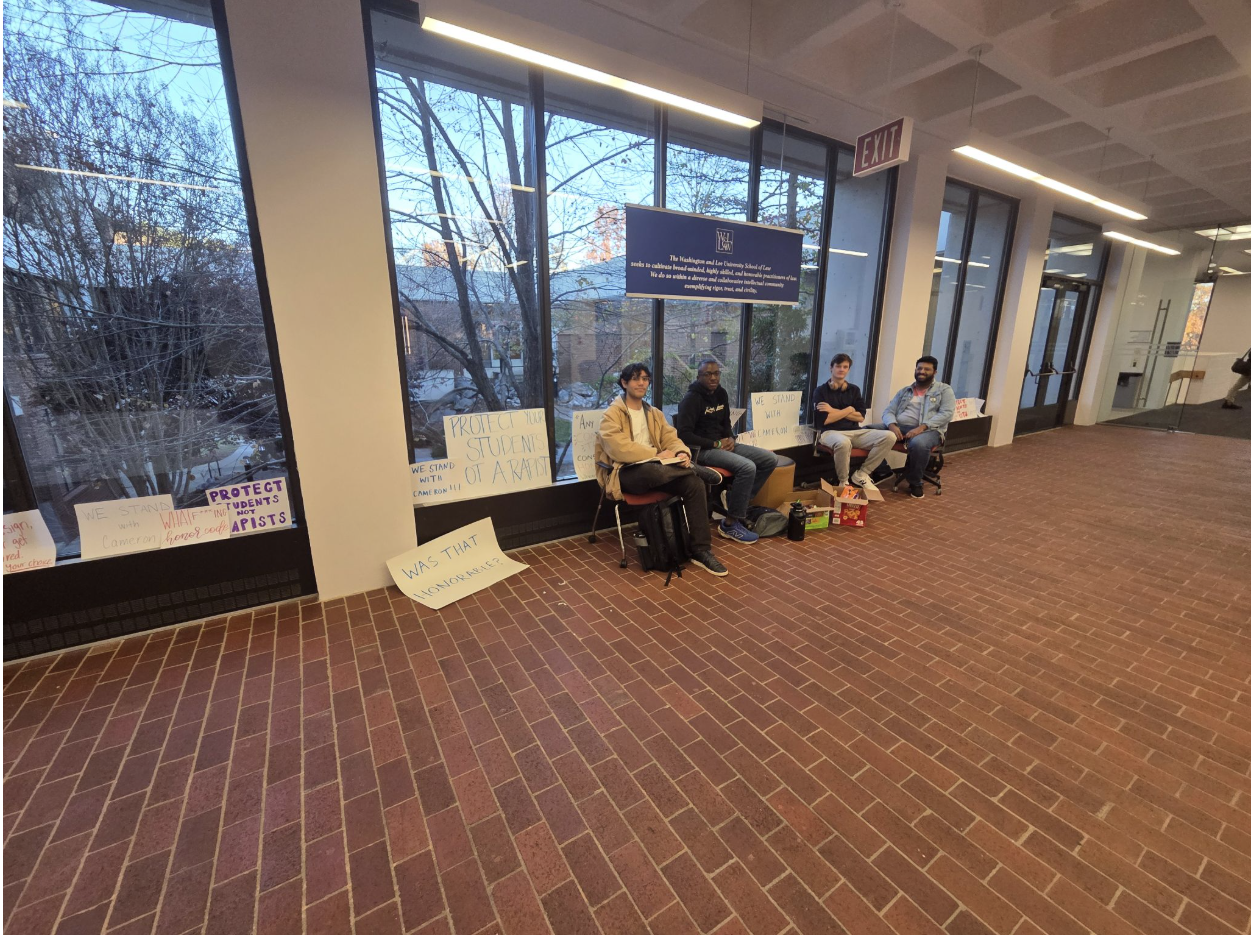
(W&L Law students protest in the lobby of Sidney Lewis Hall on November 17. | SOURCE: Alex Kagan)
Cayleen Hall, ’28L, one of the lead organizers of the student protest and the Class of ’28L vice president, voiced her frustration at the situation’s lack of transparency to The Spectator. “The Washington Post article was how everyone found out, faculty included,” she said. Professor Brandon Hasbrouck, ’11L, confirmed in an email to students that professors had not been made aware of Weston’s misconduct.
After the Post story was published, Hall and a few other class representatives immediately met with Wilson, where she learned that “they continued to keep him [at W&L] despite the victim reaching out about a month after being on campus for the first time.” She continued, “I believe once the victim had reached out in November 2024, that action should have been taken to protect the student body, not even just inform us because I do understand privacy laws exist.”
Hall expressed frustration with the limited information provided by the administration. She said, “I’m one of the few students that has gotten to hear things directly from the deans’ mouths and much of that has just been no comment, or I am not allowed to say,” which is reflected in the joint statement released by the Student Bar Association.
She further stated that, “I definitely think that the community of trust” between students and administrators “has been broken.” When asked how she thinks the community of trust can be reestablished, she referenced a letter signed by 38 different W&L Law-affiliated student organizations and posted on various social media platforms.
The letter called for the resignations or removal of Wilson, Maria Seaz Tatman, the associate dean of law student affairs, community, and belonging; Lisa Rodocker, assistant dean of law admissions; and Lauren Kozak, the Title IX coordinator and director of disability resources.
Other members of the W&L Law community joined in calling for resignations, including Brandon Hasbrouck, ’11L, who wrote in a self-described “open letter to my students” that “[t]he administrators responsible for these decisions know who they are. … and I believe they should seriously consider whether they can continue to serve in positions of institutional leadership.”
Hall said, “I think that answering the action items in that letter that was sent to the president and then posting it online is a good start, giving us that accountability and giving us new answers.”
Another letter responding to the situation received widespread support, being signed by 200 law students, or over half of the 369 J.D. candidates. Several of its demands have already come to fruition, including Weston’s removal from the W&L community.
It also demanded, “that the University conduct a comprehensive review of its admissions policies and screening procedures and implement appropriate safeguards to prevent individuals who pose a threat to campus safety from being admitted in the future.”
In an email by Interim President Ken Ruscio on Monday, November 16, he noted that he and the Board of Trustees “recognize that fair and legitimate questions have been raised about whether the University’s actions, including admissions decisions and monitoring student conduct,” have upheld student safety, and “will conduct a thorough and independent review of those policies and practices.”
A day later, the Board of Trustees revealed that the university had hired law firm Cozen O’Connor to conduct “a thorough and independent inquiry into the … admission of a student with a prior finding of sexual misconduct and his continued enrollment despite criminal charges and a pending trial.” In addition to the investigation, which will be led by Gina Maisto Smith, the chair of Cozen’s Institutional Response Group, who specializes in sexual harassment, the Board of Trustees announced an internal “advisory committee of current and former trustees” to work alongside the external investigation.
This advisory committee will be chaired by Jack Huffard ’90, P’28, a member of the Board of Trustees and co-founder of Tenable, a cybersecurity company. Serving alongside Huffard will be fellow trustees Jim Kerr ’86, the chairman, president and chief executive officer of Southern Company Gas, and Joelle Phillips ’95L, former president of AT&T Tennessee, alongside emeritus trustees Michael Missal ’78, a partner at IG Partners and former inspector general of the United States Department of Veterans Affairs, and Lizanne Thomas ’82L, a former partner at Jones Day, an international law firm.
A law student, who wished to remain anonymous, told The Spectator that the university’s response was appropriate to address the issues.
This student said that “[Weston] should not have been let in in the first place” and that “the Admissions office is in trouble,” but pushed back against calls to fire Wilson, who “really had nothing to do with this.”
The anonymous student noted, “[t]hey screwed up and they should be held responsible, but they have taken actionable steps to fix it,” pointing to the university’s decision to retain a law firm, Cozen O’Connor, to investigate W&L Law’s admissions processes.
According to Wilson’s testimony to the Student Bar Association, the findings of these investigations are likely to remain confidential.
The Spectator will continue to monitor the situation and accepts any short or long-form opinions on the subject from members of the W&L community.