
Where is the West?
Where is the West?
Washington and Lee University has consistently had less representation from the Western United States. Here is why that must change.
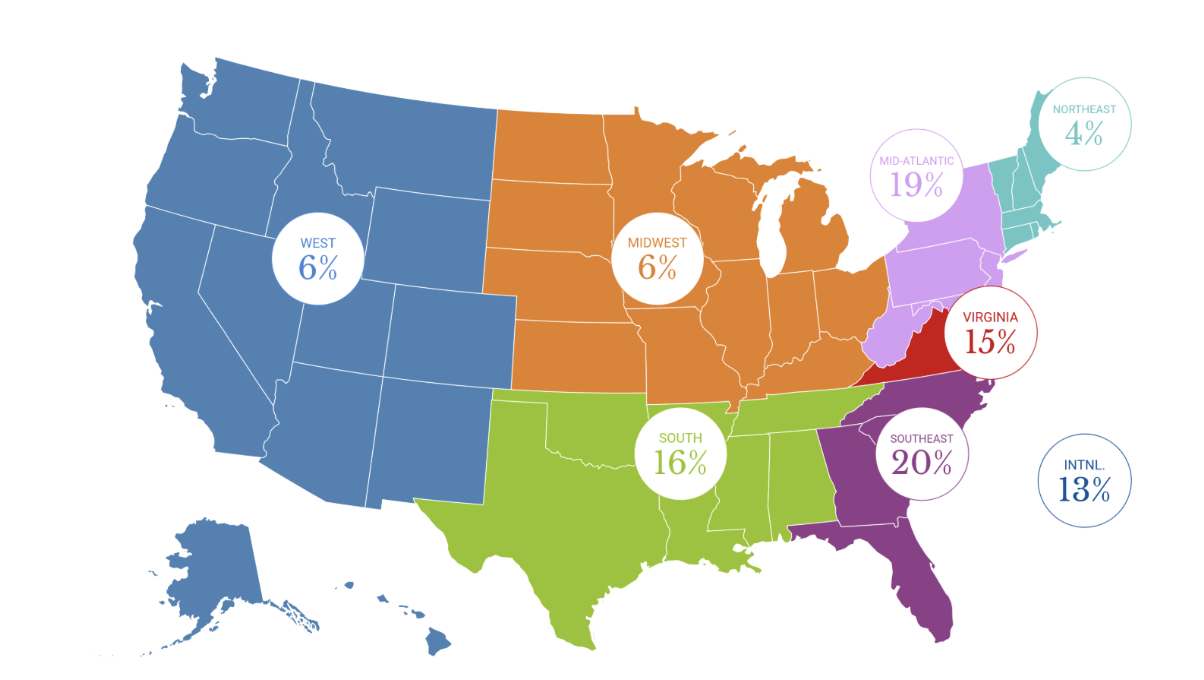
(Geographic breakdown for the Washington and Lee class of 2030 | SOURCE: Washington and Lee University Admissions)
For a region of the United States that comprises over 23% of the population, this region has been grossly underrepresented in Washington and Lee’s recent incoming classes. For the class of 2030, just 6% of the class came from the West. That number stood at just 5% the year before for the class of 2029.
It may be convenient to just dismiss this phenomenon as due to a lack of awareness from West Coasters about the school. Initially, as a student from Nevada, I thought the same thing: people simply did not know about W&L and the prestigious university it is. However, this does not match the ground realities, which show two important things. First, there are significant alumni communities in these states. Second, the name recognition for the school goes far deeper than what many people may think.
On the alumni side, there are 4 official chapters in the West Coast region - Los Angeles, Phoenix, Tucson, and Denver. A simple LinkedIn search reveals 883 alumni in California, 104 in Arizona, 373 in Colorado, and 74 in Oregon. These statistics show that W&L has a strong presence in this region, except that more alumni has not translated to more students from the region.
In terms of name recognition, the W&L name and prestige goes farther than what people may expect in the region. The summer before my freshman year, I was shocked to know how many lawyers in my hometown of Las Vegas, NV not only knew about W&L, but told me directly that it was a great school. In the 2025 summer, many Deputy District Attorneys in the Clark County, NV DA’s office made similar remarks to me.
With these two facts in mind, the problem is less about general awareness of the University, but potentially more about the University’s engagement with West Coast schools and communities, which makes prospective students unaware of the amazing institution W&L is. None of the college fairs I attended had a W&L representative present. None of my school counselors recommended the university to me. I did not receive any promotional material from the university until I already knew I was going to apply.
The reason why this should be concerning is because in the West Coast, the concentration of elite liberal arts universities is extraordinarily minimal. The only ones that have similar prestige to W&L are the Claremont, CA schools: Pomona, Harvey Mudd, and Claremont McKenna. These schools dominate the West Coast when it comes to attracting students, such as how nearly half of Pomona’s entire incoming class of 2029 came from the West Coast.
From here, we can apply some basic economics to justify an increase in university programming geared towards attracting more students from the West. In the Mid-Atlantic and Southern region, where the majority of the incoming class of 2030 hails from, W&L has to compete with several liberal arts colleges in the region. Some examples include Swarthmore, Vassar, Barnard, Davidson, Bucknell, etc. Essentially, the market is extremely concentrated for highly-ranked liberal arts institutions in these regions.
Compare this market to the West Coast market, where only 3 universities dominate this sector: the Claremont colleges. For a region where there is demand for a liberal arts education at highly selective universities, it makes complete sense for W&L to invest more in West Coast outreach. Just as how a business would tap into less competitive markets, W&L should do the same, especially because it has several advantages over the Claremont colleges that many students out West would want to know about.
The biggest one is W&L’s incredible financial aid. Pomona College in Claremont does not even offer merit scholarships. Compared to Claremont McKenna, the average W&L student receiving need-based financial aid pays close to $1000 less per year. Pairing this with W&L’s recent achievement to be need-blind and recent expansion of its tuition-free pledge, W&L offers a much better financial prospect than the Claremont Colleges, especially when factoring in the Johnson Merit Scholarship and the cost of living in Lexington versus Southern California.
The other, though probably less significant factor than financial aid, is the political ideology of W&L versus the Claremont Colleges. The Claremont Colleges are all overwhelmingly liberal, with a study finding a disproportionate amount of Democratic-registered faculty in these places. Though W&L, to an extent, has an ideological leaning, it is not nearly as pronounced as the Claremont Colleges. W&L as an institution is a moderate place, where generally speaking, all viewpoints are tolerated and political extremism is almost extinct from our university. Compare this to Pomona’s protests, where the College itself discussed the vandalism and blocking of entrances on campus by protesters. At Claremont McKenna, a poll showed that 61% of students believed it was acceptable to shut down protests and 28% believed it was acceptable to use violence.
I am confident that if more students knew about W&L, both with regards to its academic prestige and generous financial aid, more students would apply and the number of extremely talented students would only increase. The problem is, for many students out West, they simply have no idea.
Imagine if a pre-law or finance-driven student from Arizona attends a college fair and speaks to a W&L admissions representative. They learn about W&L’s incredible job placement, robust academic programs, and see its top rankings in many different schools. That student then hears about the University’s incredible merit and need-based financial aid. I find it hard to imagine that the student does not apply to W&L. I know that if this was me, that is what I would do.
Sending one representative to Phoenix, Las Vegas, Los Angeles, Seattle, or Denver could mean hundreds of new applicants with just one trip. Reaching out to top high schools in the region could increase that even more. Working with the alumni chapters to host information sessions in big cities could educate more prospective students about our great university. More applications would generate more money for the University and allow it to seek out highly-talented students who would otherwise have never even heard of W&L.
I am extremely grateful to be one of the few W&L students from the West. But I know that both the University and West Coast students would be better off if the University invests more into its regional outreach. It would be a pivotal step to making W&L a household name across the country.
The opinions expressed in this magazine are the authors’ own and do not reflect the official policy or position of The Spectator, or any students or other contributors associated with the magazine. It is the intention of The Spectator to promote student thought and civil discourse, and it is our hope to maintain that civility in all discussions.