

Court Packing: Democracy’s Dagger
A core threat to the rule of law moves in silence, and it is up to us to expose it.
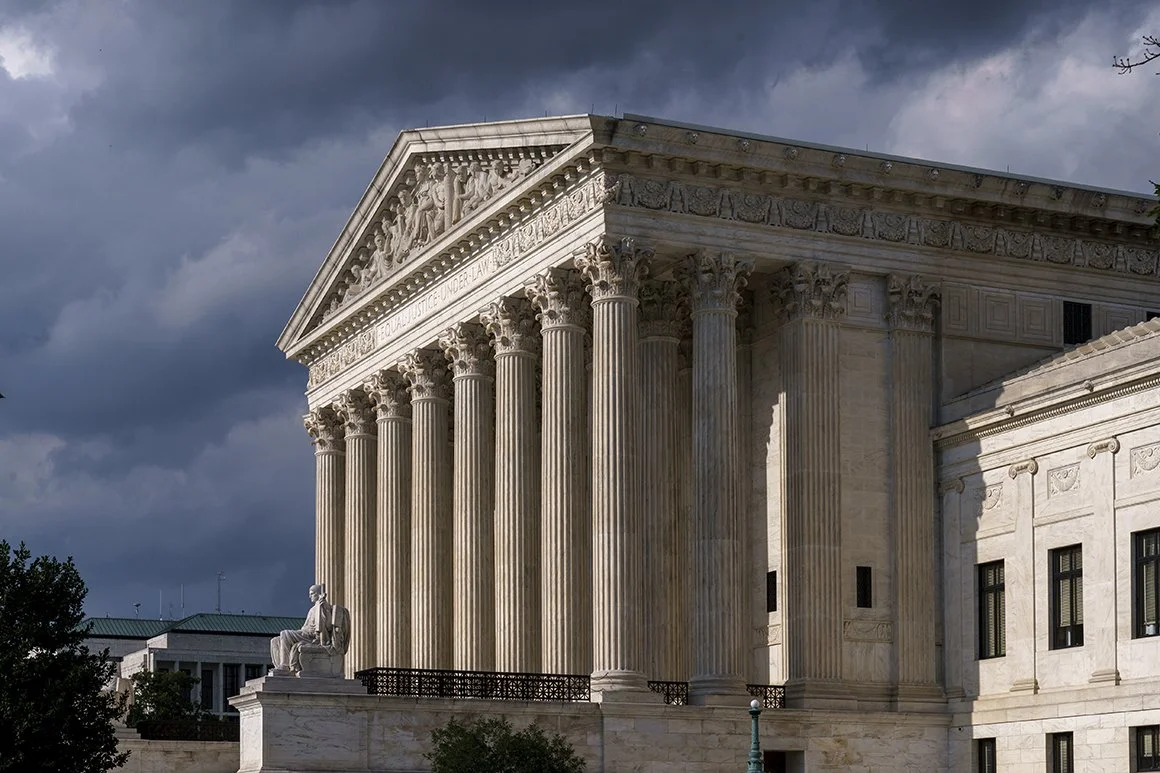
(United States Supreme Court Building, Washington, D.C. | SOURCE: J. Scott Applewhite / AP Photo)
On both sides of the political spectrum, young voters are inundated with rhetoric urging them to act to “prevent democracy from slipping away.”
The right warns voters about fraudulent election interference. The left warns voters about the expansion of executive power by President Donald Trump, reinforced by Supreme Court decisions such as Citizens United v. FEC (2010), which limits Congress’s ability to restrict independent expenditures, and Rucho v. Common Cause (2019), which prevents federal courts from blocking partisan gerrymandering.
In both cases, the institution ultimately responsible for resolving these disputes is the judicial branch, led by the Supreme Court.
While the Court has always been ideological, it has historically remained less openly partisan than the other branches of government. Judges appointed by Republicans, including by President Trump himself, dismissed his claims of election interference. A Biden-appointed judge, Judge Amir Ali of the United States District Court for the District of Columbia, recently dismissed the Democratic Party’s lawsuit, which challenged a Trump executive order on the grounds that it undermines the FEC.
Even the author of Roe v. Wade (1973), Justice Harry Blackmun, was appointed by a Republican president. Many of the Court’s most consequential decisions have emerged when justices acted against the expectations of the party that appointed them.
Because of this independence, voices on both sides now call to “pack” the Court by changing the number of justices for political advantage.
With a conservative majority on the Court today, these calls have largely come from Democrats. During Joe Biden’s presidency, dozens of Democrats backed legislation to expand the Supreme Court to 13 justices, thereby restoring a liberal majority.
Such a proposal risks opening a Pandora’s box that permanently destroys the judicial branch as an effective check on legislative and executive power. Any party that alters the Court's size invites retaliation, reducing the judiciary to a tool of the legislative majority that most recently expanded the Court.
This threat is not theoretical. President Franklin Delano Roosevelt, frustrated that the Court struck down New Deal programs, attempted to expand it after Congress fixed the number of justices at nine in 1869. Even with his immense popularity, he failed, and Congress rejected the plan. This upheld a public commitment to preserving the Court as an independent branch, preventing the institution from becoming a partisan instrument.
The respect for tradition and institutions that has preserved the Supreme Court has been weakened in the last twenty years. The reason Justices Neil Gorsuch, Brett Kavanaugh and Amy Coney Barrett could be confirmed without a filibuster traces back to 2013, when Democratic Senate Majority Leader Harry Reid invoked the “nuclear option” and eliminated the filibuster for district and appellate court nominees. In 2017, Mitch McConnell extended that precedent to Supreme Court nominations. The result has been a confirmation process increasingly driven by narrow partisan majorities and the appointment of more polarizing justices.
Political escalation in the confirmation process has now made the Court itself a target. Once a precedent is violated, a spiral is difficult to stop. If left unchecked, the erosion of confirmation norms could culminate in the Court’s expansion, placing its legitimacy and structure in question.
Recognizing this danger prompted action. In 2020, a bipartisan coalition of former state attorneys general proposed a safeguard. Led by former Virginia Attorney General Andy Miller, the group introduced the “Keep Nine” Amendment to the U.S. Constitution, which proposes: “The Supreme Court of the United States shall be composed of nine justices.” Its purpose is straightforward: to eliminate the threat of court packing and preserve judicial autonomy.
In an act of principle over party, the amendment was first introduced in Congress by former Representatives Collin Peterson (D-MN) and Denver Riggleman (R-VA). It is currently sponsored by Senator Ted Cruz (R-TX) and Congressman Dusty Johnson (R-SD), and has secured more than 200 cosponsors in the last Congress. Since Collin Peterson’s introduction, however, Congressional politics have shifted. Today, all current co-sponsors of the amendment are Republicans.
That said, polling shows a plurality of Democratic voters favor an amendment to stop court packing.
At the state level, bipartisan support for the “Keep Nine” Amendment remains strong. In Texas, eight of 11 Democratic state senators recently voted for a resolution supporting the Amendment and opposing court packing.
That gap between voter sentiment and congressional action shows why younger Americans should take a particular interest in the issue. Regardless of party and background, the security of our nation’s institutions should be of utmost priority to the generation that will inherit the result of our leaders’ current decisions.
This is exactly why I am leading a bipartisan student organization that wants to permanently end the threat of Supreme Court packing through the Keep Nine Amendment. The Students for Keep Nine is a network of students bringing light to this issue on over 15 campuses nationwide.
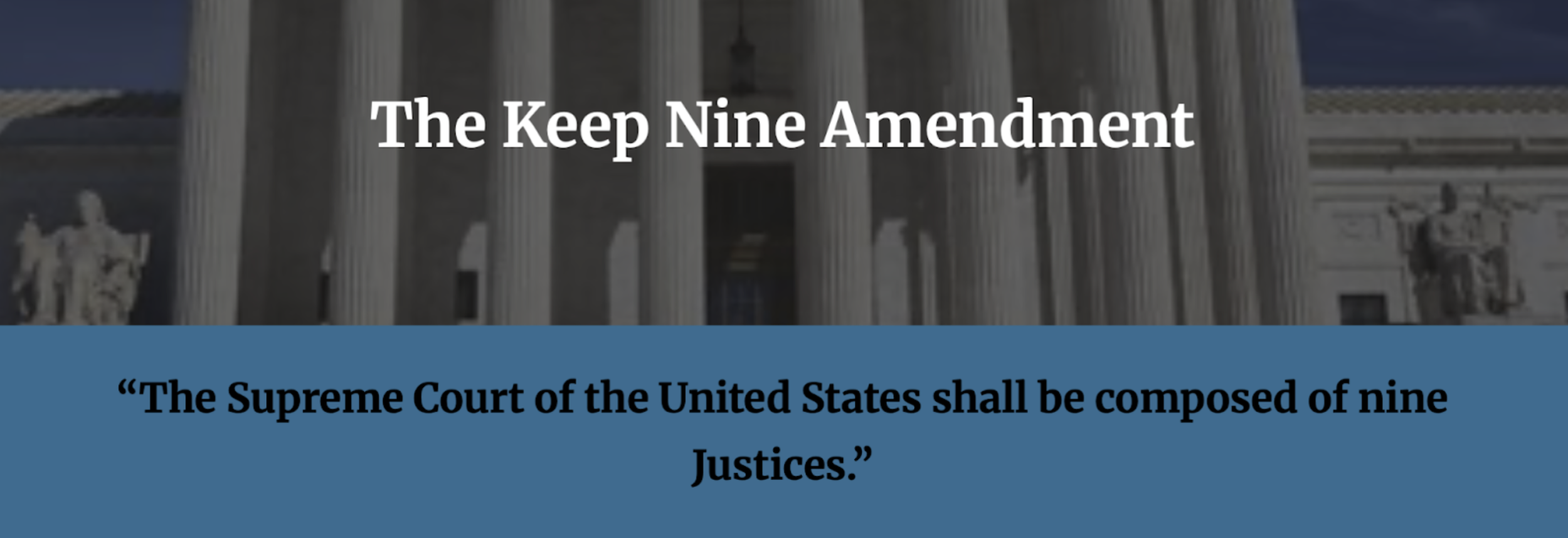
(The Keep Nine Amendment’s text | SOURCE: Keep Nine Amendment)
The Keep Nine Amendment is not about which party is in power. It is about ensuring the Supreme Court is never reduced to being a political weapon. If the Court is packed, each expansion will move it further from its intended role and inflict lasting damage on the country’s most delicate institution. If it remains fixed at nine, the Court can continue to serve as a stabilizing force in the constitutional order.
If the Supreme Court becomes another front in partisan escalation, it risks becoming democracy’s dagger rather than its shield. At a moment when democratic legitimacy is already strained, a student push to preserve the Supreme Court’s structure may be a necessary inflection point back towards the rule of law.
The opinions expressed in this magazine are the authors’ own and do not reflect the official policy or position of The Spectator, or any students or other contributors associated with the magazine. It is the intention of The Spectator to promote student thought and civil discourse, and it is our hope to maintain that civility in all discussions.